I spent years in academia, more years at a national laboratory rooted in academia, and years again at Bell Labs and two of its spin-offs with a long tradition in research and development. The lab notebook was a fixture at all of these places. Yet its utility wasn't apparent to me until I began freelancing. Go figure. Now I wonder how I ever lived without it. It's a tool for organization, an indispensable part of my billing process, a cache memory, and an archival storage mechanism, all rolled into a handy item that fits in a briefcase or a file cabinet.
 The lab notebook is traditionally a hardbound notebook with blank ruled pages, and there are still plenty of folks that use those, especially if the company is paying for them. But it can also be nothing more than the spiral bound notebook like you may have used in college. I use something in between. John Dickinson is a British company that makes a series of spiral-bound Black n' Red notebooks with plastic covers. I use them exclusively as my lab notebooks. They are sturdy and handle the occasional beverage spill. The fact that they are in my two favorite colors is just icing on the cake. Each client has their own notebook, and I label the front with the client's name and a sequential number. I typically go through a notebook every two months, more or less, on a project. Although they come in ISO standard sizes (i.e. not 8.5" x 11") they still fit in a standard file cabinet. The elastic strap riveted to the back cover keeps all my ancillary crap from falling out.
 I'm always collecting odd scraps of paper, notes, and odds and ends that fit nicely in the pocket at the front of the notebook. I use TUL-brand gel pens almost exclusively, which I buy in boxes of a dozen at OfficeMax. Their ink can't be easily erased, they are reliable, and (most importantly) they fit inside the spiral binding of the notebook.
 I make a note of the date at the start of every working day, and make a note of at least my start and stop times. I can usually reconstruct what I worked on that day, and approximately for how long, just by perusing my notes. (You may notice that the dates on these pages are over four months apart. Some projects work that way.) Symbols in the margins give me further guidance: stars are actions items and must be checked off; asterisks mark information that I am likely to need later; question marks are things I need to find out; arrows point me forwards or backwards to related information.
Note that my lab notebooks are the intellectual property of my company, Digital Aggregates, not of the customer. I have never had a customer question this, but sometimes it pays to be clear. If a customer calls or e-mails me with a question, the notebook comes out of my briefcase or file cabinet. Given the occasional senior moment, I've been known to refer to my archived notebooks to remember how to do things like a Linux kernel build.
 I keep my own weekly time cards that I use for invoicing. Data from this paper form gets entered into a QuickBooks time card, which I use to generate monthly invoices. This paper time card also gets covered with notes like customer project numbers and billing codes. I keep a PDF version of the time card form on the web so I can always print a blank one at a customer site. I've never had a client that required me to get a signature on my time cards, but several of them do require me to use their own web-based time card system, which is very reasonable. I make sure that the customer time card and my time card agree. Accountants Payable departments don't like surprises, even if it means being invoiced for less than amount indicated in their own system. (I learned this the hard way. Never round down. In fact, never round at all. A fifteen minute discrepancy in the client's favor nearly meant a month delay in getting paid.)
In A Future Without Keyboards I mentioned that I also use a Palm T|X PDA to help stay organized. It keeps my calendar, my contact database, and a lot of notes, and I keep it synced to my ThinkPad X61 laptop. When I travel light, I carry a Nokia N810 internet tablet to keep up with email and web cruising.
But I have also learned not to depend too much on anything that requires electricity. (For example, I wear a self-winding mechanical wristwatch.) Hence, the lab notebook and the paper time card, both of which have served me well.
Update (March 2010): I recently replaced my Palm PDA, ThinkPad, and Nokia with a Blackberry 9630 Tour and an Apple MacBook Air. The Tour supports both CDMA and GSM standards, so it pretty much works anywhere in the world (or at least in my experience, everywhere I've gone in the U.S., Canada, and the U.K.). Plus, it serves as not only a phone, but a GPS receiver, MP3 player, digital camera, address book, date book, alarm clock, web browser, email client, and what have you. The MacBook Air is so light and thin that I have no qualms schlepping it through airports. I still use the Nokia for motorcycle trips, though.
Update (December 2012): Some years ago I replaced my Tour with a Blackberry Bold, and just recently the Bold with an iPhone 5. I still have the Air, but when I travel I typically take an iPad unless I know I'm going to have to do a lot of content generation. I chose the iPad model with a cellular modem partly because the cellular chip set includes true GPS support. Now that I have the iPhone, my next iPad may just be the WiFi model.
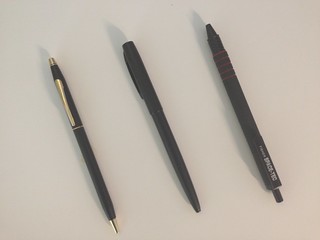
Update (2016-07-26): Lots of changes over the past four years: I still have my iPhone 5, but my laptop is a 13" MacBook Pro, and I'm on my second iPad. One of the most useful upgrades I did was to my daily writing implements. One morning I picked up a gel pen on my desk and it had dried up -- a persistent problem with gel pens, regardless of the brand, in my experience. I picked up another: the same. Another. And another. Finally I got on Amazon.com and ordered a batch of Fisher Space Pens. They make many different models, all refillable with the same refills. Plus, they make refills compatible with Cross ball point pens, so you can use that nice gold pen you got as a gift. That's exactly what I've done. Below is a photograph of three different pens I had immediately at hand: the Cross pen I keep in my shirt pocket, the Fisher metal-body tactical pen I keep in my current project notebook, and a Fisher Space-Tec plastic-body pen I keep in a small notebook in my briefcase. The pens and refills are rock solid reliable, they write smoothly, and the refills last nearly forever. If it works for the astronauts, it'll work for you.


No comments:
Post a Comment