Tuesday, February 02, 2021

Anticipation

You may have read by now that the online vaccine management system that the Trump administration paid US$44M for from the consulting firm Deloitte in a no-bid contract is a disaster. Riddled with bugs like making and then randomly cancelling appointments. States are giving up and cobbling together their own solutions.

Cat Ferguson, "What went wrong with America’s $44 million vaccine data system?", MIT Technology Review, 2021-01-30
About half my career has been spent doing work funded by the U.S. government, either in Big Science or in the Military and Intelligence sector. What I found the most interesting about this mess is one of the reasons Deloitte got the non-competitive contract in the first place. Did they have any experience in large scalable distributed medical computer systems? No. Infectious diseases? Nope. Vaccination programs? Not even. What they had experience in is government contracting. And the procurement systems implemented by the feds make it difficult - not to mention less profitable, compared to other work in the commercial sector - for anyone who isn't already doing government contracting to do government contracting.

I'm reminded of when Google bought Boston Dynamics. The robot company had been mostly funded by DARPA, the U.S. DoD's advanced research arm, the folks that have a track record of bringing us things like the Internet. Once Google bought Boston Dynamics, they declined to renew the DARPA contract. The DoD-related industry was surprised; I read articles in the DoD trade and national security press about this at the time. But I doubt many in the high tech industry even batted an eye. Selling to the Feds used to be a big thing. Now, not so much, compared to the global market. (Google eventually sold the company to Hyundai. Yet another bleeding edge albeit immature technology transferred to a foreign company.)

Another issue that occurs to me is how long it takes to design, develop, test, and deploy a product as big and complex as the proposed vaccine management system. Contrary, I suspect, to expectations in the White House at the time, a commercial effort of this type would take a year or two, all told. Regardless of the sales pitch from any consulting company, there is no fast path. That's why you have to anticipate this kind of need, and address it well in advance of it becoming a necessity. It's like insurance: you have to buy it before you need it, with the understanding - and the hope - that you never actually have to use it.

I don't know how, but we need to do better.

Wednesday, January 27, 2021

1995

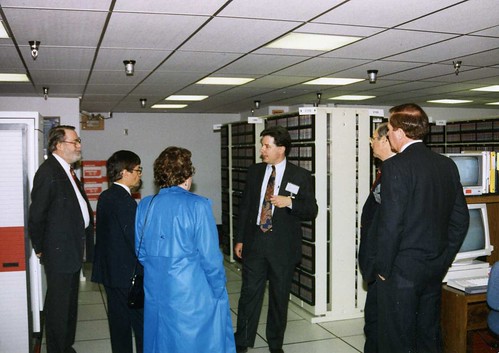
 Back around 1995 I was a section head in the Scientific Computing Division at the National Center for Atmospheric Research (NCAR) in Boulder Colorado, a national lab sponsored by the U.S. National Science Foundation. Besides leading VIPs around on tours, at that time I was involved in helping write proposals, papers (one of which was the featured article in the Proceedings of the IEEE), patent applications, and design documents for a terabyte hierarchical Mass Storage System, the next generation of NCAR's groundbreaking data storage architecture. The existing NCAR MSS had a floor-full of offline tapes and tape drives, several robotic tape silos, and a pile of disk drives. That is what it took to feed data to NCAR's several supercomputers and to soak up the results. A terabyte was an almost unbelievable amount of storage at the time.

Manager

This morning I'm continuing to work on my latest project, which incorporates a two terabyte Solid State Disk - no moving parts - so small it would easily fit in my shirt pocket. I bought it off Amazon because our local office supply store only had the one terabyte model of the same drive, and I needed something larger. The SSD is USB attached to an equally pocket-sized US$75 Raspberry Pi 4B Single Board Computer, which also provides all of the SSD's power.

Untitled

1995 just doesn't seem that long ago.

Saturday, January 09, 2021

Three Laws Safe

I'm a fan of Ben Thompson's business analysis blog Stratechery. It's hard to say exactly what it's about. His background (such as it is; he's actually younger than his writing and analysis would lead you to believe) is an M.B.A. from the Kellogg School and a relatively brief career in marketing and strategy. But what he writes about is far broader than that. Even if I don't agree with him, he gives me much to think about.

His latest article, "Trump and Twitter", is why he supports Twitter's blocking of President Trump. This is not the first time that he has written that social media companies have to have the following priorities, from highest to lowest:

  1. liberalism is inviolable;
  2. democracy must be respected;
  3. bad policies should be opposed.

Here, liberalism isn't used here the Big-L Liberal political sense; it is used in the small-l liberal sense that we are

  • governed by the rule of law, and
  • have a guarantee of individual rights and personal liberty.

This is the way it's meant in the phrase "liberal democracy".

This is kinda like Asimov's Three Laws of Robotics: democracy only if it doesn't violate individual rights (the majority can't vote to take away someone's individual rights except in the case of the rule of law); oppose bad policies only in as much as they respect democracy and don't violate the rule of law or individual rights. And you have to remember that rule of law is the first liberal requirement.

I confess I'm still trying to decide whether I agree completely with this list of priorities; I'm inclined to say that I do, but I need to ponder the consequences of it. For example, our First Amendment rights to freedom of speech do not protect all speech (contrary to popular belief). So in fact, banning Trump from Twitter does not violate his right to freedom of speech, because speech that promotes hate, violence, and crime is not protected; that is the rule of law. Also, our First Amendment rights are regarding what our government can do, not what a company or individual can do; no one is required to provide someone a forum for their speech, protected or not (something else that people often don't understand).

The point here is the people who stormed the U. S. Capitol were following priority #3, while ignoring #2, and the "rule of law" part of #1.

I think using these three simple priorities as a kind of ethical checklist is the way I am heading. Is it complete? Probably not. But a lot of stuff other folks would want to add would actually fall under #3, opposing bad policies. The weakness in this is that you and I (and the yahoos that stormed the Capitol) may disagree what a exactly a "bad policy" is. But even as we disagree, we surely can agree that #1 and #2 come first.

Once you and I can agree on #1 and #2, we can have a civil, rational conversation about what falls under #3.

I look forward to that.