Showing posts with label Miscellaneous. Show all posts

Wednesday, August 02, 2023

Boom Town

In 1969, a forty-kiloton nuclear bomb was detonated underground in Colorado, near the town of Parachute, between Glenwood Springs and Grand Junction, west of Denver and a little south of what is now Interstate 70. The test shaft was over 8,400 feet deep. It was a test to see if small nuclear devices could free up natural gas deep underground, part of Project Plowshare. Edward Teller, one of the developers of the H-bomb, was there during the test.

In 1973, three thirty-kiloton nuclear bombs were detonated underground in Colorado, in Rio Blanco County, in the northwestern part of the state. It was another Project Plowshare effort to find peaceful uses for nuclear bombs.

These efforts to extract natural gas were a partial success. Partial because the gas was so radioactive it could not be sold, so was instead burned off.

As a result, Colorado passed an amendment to its state constitution such that approval for the detonation of a nuclear device in the state has to pass a state-wide popular vote. It is the only state in the U.S. with such a requirement.

This all happened before the Spousal Unit and I moved to the Denver area in 1989. But that's not the only adventure with radioactivity you may find in Colorado.

Given the depth of the H-bomb detonation near Parachute, the site is probably not nearly as radioactive as the site of the old Rocky Flats Nuclear Weapons Plant, between Denver and Boulder Colorado, just a few minutes drive from my home, and which I drove right past when I commuted to Boulder every day to work in the early 1990s. Rocky Flats - somewhat euphemistically - manufactured triggers for nuclear bombs; the trigger for a nuclear (fusion) bomb is an atomic (fission) bomb. Rocky Flats was an EPA superfund site for a long long time after it closed in 1992, following an FBI raid.

Radioactivity is a natural phenomena here in Colorado, thanks to decaying uranium ore underground that creates radioactive radon gas. Like a lot of folks in our neighborhood, we have radon mitigation in our home: a fan that runs 24x7 that pulls air (and presumably radon) out of our crawl space and exhausts it above the house.

Huge piles of mine tailings around Colorado mountain towns contain a lot of uranium ore, which was just a waste product when it was originally dug out during the gold and silver mining era. No one at the time had any idea they were creating an environmental hazard that would last, for all practical purposes, forever.

For reasons unrelated to any of this, my tiny little company owns a couple of geiger counters. One day, the Spousal Unit asked me if my watch with a tritium dial gave off enough radiation to be detectable. Good question. Tritium is a radioactive isotope of hydrogen. Its radioactive decay produces helium, an electron (a.k.a. beta particle), and an electron anti-neutrino. Tritium watch dials have hour and hand markers that are tiny vials containing tritium gas and a phosphorescent compound. The beta particles from the decaying tritium excite the phosphor, making it glow. No external light source is needed, although in time all the tritium will have decayed and the vial will stop glowing. Gun sights for use at night may use this mechanism too.

I swept one of my geiger counters close over the watch, and got a reading of normal background radiation. Beta particles from tritium decay are so feeble energetically that they typically can't penetrate more than about a quarter inch of air, much less human skin. Most probably can't make it past the wall of the vial.

Then, I happened to sweep the geiger counter across one of my other watches, where it went completely nuts. It turns out an old mechanical French Army surplus watch from the 1960s that I own has a radium dial. I had no idea; that wasn't in the original description when I purchased it. Radium is a decay product of naturally occurring uranium, and radon gas is in turn a decay product of radium. As it decays, radium produces ionizing radiation in the form of helium nuclei (a.k.a. alpha particles) and gamma radiation.

That watch dial was hot. The watch now resides in a lead-lined envelope on a shelf in the basement, along with some samples of uranium ore.

In these parts, it's no accident that we all have a healthy glow.

References

Westword, "The Boom Years", 2023-07-30

Wikipedia, "Rocky Flats Plant", 2023-06-19


Saturday, June 10, 2023

The Expanse of Cosmic Horror

(This blog article is a mash up of two long social media posts I made some time ago, so it might seem a little fragmented and repetitive, even though I've tried to edit it a little.)

The late H(oward) P(hillips) Lovecraft [1890-1937] is credited with inventing the genre of cosmic horror - one of my favorite genres in either print or visual media. I don't classify his iconic creation Cthulhu as comic horror. That gigantic octopus-headed other-worldly creature that lies dreaming deep under the sea in the impossibly ancient city of R'lyeh is way too anthropomorphic. Cthulhu is horrifying, sure, but cosmic horror is all about reality-bending stuff that comes from non-earthly realms and virtually defies description. Cosmic horrors aren't evil; they are indifferent, as uncaring about their impacts on us puny humans as a lawn mower is to ant hills. Cosmic horrors drive humans mad because of our inability to perceive and process their reality.

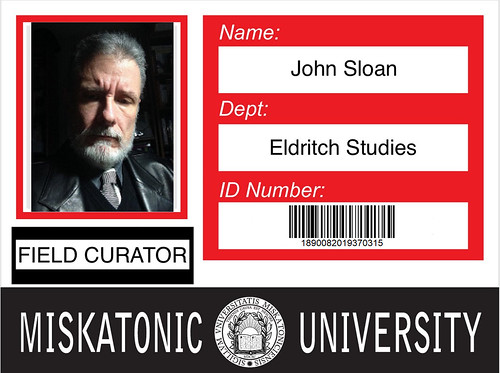
Propnomicon Miskatonic Badge Edit

My affection for cosmic horror is one of the reasons my alter ego goes to science fiction conventions wearing pins or badges that identify him as a faculty member at Miskatonic University - that fictional university in an equally fictional Arkham County, Massachusetts situated on the banks of the still fictional Miskatonic River, where several Lovecraft stories take place.

(And in case you're wondering, there is absolutely no excuse for the terrible racism evident in some of H. P. Lovecraft's writing. In this respect he was wrong and ignorant, even for the time in which he lived and wrote, and that part of his work is repugnant and not to be admired. But I learned long ago that if I only love those who are perfect, I will come to love no one. So I celebrate his other work while decrying that part of his milieu.)

Cosmic horror is one of the reasons that, with some exceptions, I can't quite enjoy reading science fiction that casually features faster than light (FTL) travel or communication. (I'm just a little more forgiving of visual media in this respect, but not much.) My dilettante reading of physics leads me to interpret FTL as creating circumstances that would bend or break our very perception of reality, eliminating our ability to agree on basic cause and effect. It would lead to violations of the basic laws of physics - which is perhaps part of the definition of cosmic horror.

Here are some media - not intended in any way to be comprehensive - that I think fits the description of cosmic horror.

  • John Carpenter's movie The Thing and John W. Campbell's novella "The Thing From Another World" on which it is based, is by far the best known example. (The Carpenter movie is also a great example of another horror genre, body horror).
  • The movie Alien (but not so much the terrific sequel Aliens) shoots for a bit of cosmic horror, with an alien which could easily have been right out of Lovecraft's "Cthulhu Mythos", although it has the same anthropomorphic flaw as Cthulhu itself. [added 2023-06-19]
  • The movie Event Horizon for sure has elements of "things man was not meant to know", all the result of the development of an FTL drive. [added 2023-06-19]
  • Jeff VenderMeer's book Annihilation and the movie adaptation of the same name starting Natalie Portman was all about cosmic horror. (The book is part of a trilogy; I recommend the second and third books too.)
  • The later books in James S. A. Corey's nine-novel series The Expanse are definitely cosmic horror. (The television adaptation didn't last long enough to really get to those parts.) The alien FTL technologies and nano-technology found by humans in the later parts of this epic series are not at all understood by the scientists, and they are appropriately horrified by their non-local behavior. (James S. A. Corey is the pen name of the authorial partnership of Daniel Abraham and Ty Franck.)
  • And perhaps most controversially, even as most of it was based on the real science and technology of its day, I find Stanley Kubrick's movie 2001: A Space Odyssey to have elements of cosmic horror.

I’ve been thinking about this for some time now: The Expanse is obviously a great hard-SF saga of humans colonizing the solar system - and, eventually, beyond. Both the books and the television adaption are careful to obey the laws of physics, e.g. no FTL, no artificial gravity, and force, inertia, and momentum are all a bitch. But it’s not just that. In my opinion, it’s fused with a great story of cosmic horror, in the Lovecraft tradition, if H. P. Lovecraft had had some physics courses. (Lovecraft was in fact a great fan of astronomy in his time.)

I like to say that we really don’t want faster than light travel. When Einstein wrote

E = mc2

E was energy, m was mass, and c was… the speed of light in a vacuum? Not really.

The speed of light isn’t fixed. It has a top speed in a vacuum, but travels more slowly - indeed, sometimes more slowly than other particles - when going through a transparent medium. (That’s what causes the glow, called Cherenkov Radiation, in water-immersed reactors; particles that are the result of atoms fissioning travel through the water faster than photons, which in turn produces more photons.) But more weirdly: the speed of light is a particular medium is a constant for all observers in inertial reference frames (that is, moving but not accelerating), regardless of how fast each observer is moving relative to one another.

This is what special relativity is all about. If that weren't the case, stuff like the chemical reactions in our bodies that are necessary for life wouldn't work reliably. And keep in mind, we are all in motion, all of the time: we move on the surface of the Earth, the Earth orbits the Sun, the Sun travels through the Milky Way galaxy gravitationally dragging all of its planets along with it, the Milky Way moves through its local galactic cluster, the cluster... well, as far as we know, there's no end to it. All in motion, all of the time. There's no such thing as standing still. And if there were... standing still relative to what?

The variable c isn’t really the speed of light, in a vacuum or otherwise; it’s the speed of causality, the maximum speed at which cause-and-effect can travel. In a vacuum, light travels at this speed.

(Update: as far as I know, there is no definitive answer as to what Einstein and his peers had in mind when they chose c to stand for the speed of light in a vacuum; some have suggested it stands for constant.)

Special relativity is strange enough, in that observers, in different locations and traveling at different speeds in different directions, may legitimately disagree on the order of two independent events, “independent” meaning that those events are not connected directly or indirectly by cause and effect. There is no correct answer as to which event occurred first; it all depends on your point of view.

If we had faster than light travel, or faster than light communication, this gets even worse. Really, our basic perception of reality would come into question. We might not just disagree on the objective order of events, but information about events could arrive before the events apparently occurred. This is actually kinda scary.

Scary in a cosmic horror kind of way.

35119316115_f07e568a4f_o

As I said before, while I’m a fan of H. P. Lovecraft - my alter ego has Miskatonic University business cards he uses for non-work related stuff - I find the popular conception of Lovecraft's creation Cthulhu to be way too anthropomorphic. The mere fact that we can describe Cthulhu - it (apparently) has an octopus head, a humanoid body, wings - means it's really not a cosmic horror. A true cosmic horror would be more of what Lovecraft meant when he wrote of people being driven insane because they could not possibly comprehend, much less describe, what they were witnessing and experiencing.

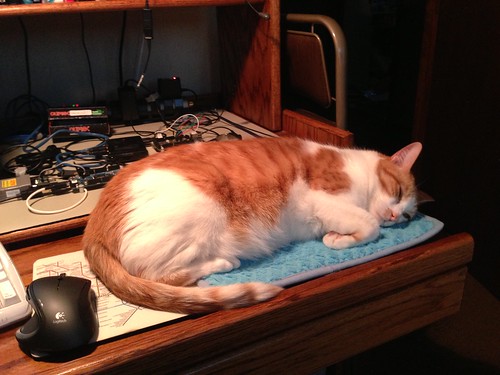
IMG_5389

One of the things I liked about The Expanse books is that the scientists experimenting with the protomolecule and with the ring gates - both extraterrestrial technologies which humans manifestly did not understand any more than my cat understands my laptop - were actually deeply disturbed by the protomolecule's non-local behavior, and by the gates’ faster than light travel. And rightfully so. Lovecraft fans in The Expanse universe would have known that it would not end well. Technology that enables faster than light travel, and non-local behavior, is inevitably going to be a kind of cosmic horror, driving people mad with its non-Euclidian geometries.

Untitled

So I have come to think of The Expanse series as a fusion of the hard-SF genre and the cosmic horror genre (with a little bit of body horror thrown in for good effect). I would not be surprised to find that the authors Daniel Abraham and Ty Franck had that in mind from the very beginning.

Saturday, June 03, 2023

The Short Tail

Way back in 2004, Chris Anderson, who was then editor in chief of WIRED magazine, wrote an article, and later a book, about "The Long Tail". The idea is that technology and economics have made it possible for companies to provide some kinds of products for which each individual item might have low demand, but the number of items would be so large, that it would be profitable. The classic example of this was Netflix, from which you could rent a DVD of an obscure movie from decades ago; that DVD might not even exist until it rose to the top of your Netflix wish list, at which point it could be manufactured onto a physical DVD from a digital archive, and then shipped to you. Another example is Amazon.com, which provides an enormous variety of physical items, leveraging warehousing and logistics to keep costs low on low volume items. (The title comes from the shape of the graph where you plotted the demand for each item against the number of items; the head of the graph was high, representing the big hits, but the tail, although low, trailed off almost to infinity, containing all the niche products.)

Great idea. But those days are over.

Netflix, as everyone now knows, is dropping its DVD rental service in favor of internet streaming. Wow. Great. Except the number of movies it provides via streaming is a tiny fraction of what was available before on DVD. This orphans our long Netflix wish list, which was full of old classic movies that I hadn't seen, but wanted to.

Just a couple of days ago, the Spousal Unit had other plans, and I sat down with the TiVo remote control and laboriously searched for The Ipcress File, a 1965 spy thriller with a young Michael Caine, and Paint Your Wagon, a 1969 musical western with Lee Marvin and Clint Eastwood. No luck on either movie, on either Netflix or with Amazon Prime, the latter of which I thought might work even if I had to pay a few bucks for either movie.

So much for the idea that internet bandwidth, and digital storage, being so cheap that virtually any digital media would be easily and almost instantly available. This is not the future I was promised in lieu of flying cars.

Today I read that Disney is dropping a pile of shows and movies from its streaming service. Why? Money, of course. This will - somehow - allow it to write-off US$1.5B dollars. This is existing content, which costs almost nothing to store and deliver technically, but may of course incur licensing fees to its creators. Including some of the very same writers that are currently on strike to protest in part terrible labor practices by production companies and giant media conglomerates.

I'm a capitalist at heart - I have to be, my income depends on it - but this is some kind of late-stage capitalism market failure.

Tuesday, November 29, 2022

The Enrollment Cliff

In 2007-2008 the sub-prime mortgage debacle led to the Great Recession, which in turn led to a drop in the birth rate. Fourteen years later, the Denver Colorado public school board is debating whether to close ten schools in the city/county due to low enrollment (and reduced tax income). Jefferson County Colorado (where I live) is having similar discussions. As you might guess, this is controversial with parents.

A week ago I read this in Vox

https://www.vox.com/the-highlight/23428166/college-enrollment-population-education-crash

which I'm now seeing referenced other places: colleges and universities are facing a similar "enrollment cliff", not just due to the birth rate, but from high school students selecting career paths other than college.

Pursuing a career path that does not include a college degree is a decision which I do not disagree - not every career requires a college degree, contrary to popular opinion (mostly from college marketing departments). And some extraordinary individuals can get all the training and knowledge they need through rigorous self-directed learning, even in technology fields like mine. (It's been my privilege to work with a few terrific folks like this.) But they are the exception, not the rule. Not every person has that skill set.

(I am deeply cynical however of major tech giants telling high school students that they do not need a college degree to work in the tech field, merely a certificate from specialized training. This is in not untrue. But they omit the words "perhaps for a while, and maybe at a lower salary". I wonder if the long term effect of this will be to encourage unionization in the tech field. [I don't object to this, either.])

Why do I care? For years I've been on an advisory board for the computer science department at my alma mater, so am aware of the impacts of not just enrollment but - to be honest - fads in the technology fields have on academia. And I'm watching this traveling wave of change move through the elementary and high schools, to the colleges and universities, and finally to employers.

I put my money where my mouth is on both sides of this: some years ago I endowed a modest scholarship at my alma mater in honor of my mentor and thesis advisor, the late great Bob Dixon, and I annually donate to support a lab at my alma mater that provides facilities and tools for students to do their own projects for self-directed learning (basically a makerspace supported by the computer science department).

I've also made it pretty obvious where I stand on continuous self-directed learning, by constantly doing technology projects of my own, having over thirty open-source software repositories on GitHub, and writing about all of it in this blog since 2006.

An old friend, university classmate, former fellow university employee, and one-time flat-mate of mine remarked recently that colleges are part of a free-market and are going to have to learn cost control. I agree. Although I'm concerned as much with the second order effects of this wave on our society as I am with the effects on, for example, my alma mater.

Thursday, October 13, 2022

The Time Police Play Hardball

Alain Aspect, John Clauser and Anton Zeilinger won the Nobel Prize for Physics this year for their groundbreaking experiments in the field of quantum physics that verified Bell's Theorem.

One of the more unsettling discoveries in the past half century is that the universe is not locally real. “Real,” meaning that objects have definite properties independent of observation—an apple can be red even when no one is looking; “local” means objects can only be influenced by their surroundings, and that any influence cannot travel faster than light. Investigations at the frontiers of quantum physics have found that these things cannot both be true. Instead, the evidence shows objects are not influenced solely by their surroundings and they may also lack definite properties prior to measurement. As Albert Einstein famously bemoaned to a friend, “Do you really believe the moon is not there when you are not looking at it?”

...

Blame for this achievement has now been laid squarely on the shoulders of three physicists: John Clauser, Alain Aspect and Anton Zeilinger. They equally split the 2022 Nobel Prize in Physics “for experiments with entangled photons, establishing the violation of Bell inequalities and pioneering quantum information science.” (“Bell inequalities” refers to the pioneering work of the Northern Irish physicist John Stewart Bell, who laid the foundations for this year’s Physics Nobel in the early 1960s.) 
[D. Garisto, "The Universe Is Not Locally Real, and the Physics Nobel Prize Winners Proved It", Scientific American, 2022-10-06]

https://www.scientificamerican.com/article/the-universe-is-not-locally-real-and-the-physics-nobel-prize-winners-proved-it

It might occur to you to watch a 'Tube video or two, or read a popsci article on this work (like the one from Scientific American above). I've done this, with a dilettante's interest in the matter. I urge you to be cautious, and show restraint. I'm not entirely joking.

I've been reading and watching material on this very topic for years now. And I find it deeply troubling. As did Albert Einstein and his colleagues Boris Podolsky and Nathan Rosen (who were far far smarter than I've ever been) when they wrote their now-famous paper on the "EPR Paradox". They basically argued "the universe cannot work this way".

But alas, the results of actual experiments performed by these Nobel laureates (and which, remarkably, you can duplicate some of which just using three linear polarizing camera lens filters, which I've done) prove that indeed the universe is not "locally real". As John Stewart Bell (who died before winning a well deserved Nobel himself) showed, quantum physics implies that one of two things must be true: either things can interact in a non-local manner (exchanging information faster than the speed of light), or objects do not have intrinsic physical qualities (even basic stuff, like color or mass) until we measure them.

Regarding non-local behavior: I remind my fellow science fiction fans that non-local behavior does not imply that we can use it for faster than light (FTL) communication. There is no way to modulate the effect to carry data. And you really do not want FTL, since its implications for our perception of reality - regarding our ability to distinguish between cause and effect - are even more dire, an issue which becomes obvious after a little reading about Special Relativity.

Regarding the measurement issue: the idea that "objects do not have intrinsic physical qualities until we measure them" sounds suspiciously like "as an optimization, reality isn't rendered until it comes into the viewpoint of a character in the game".

This is a lot more disturbing than it might first appear. One of the possible explanations (not the only one, but perhaps the simplest one) is "superdeterminism", in which the future is every bit as fixed as the past. I've heard several physicists - both quantum physicists and cosmologists, for different reasons - say "there's no such thing as free will; get over it".

My favorite quantum physicist and science explainer, Dr. Sabine Hossenfelder, brought this topic up in her blog/vlog just recently.

Many headlines promptly claimed that this means spooky action is real. But this is not correct. Rather, the experiments showed that you either have to stick with quantum mechanics and accept spooky action, or you reject spooky action and accept superdeterminism. Which is why I keep saying we need experiments to test superdeterminism.
[S. Hossenfelder, "Science News Oct 12", Backreaction, 2022-10-12]

http://backreaction.blogspot.com/2022/10/science-news-oct-12.html

The phrase "spooky action" here refers to Einstein's description of non-local behavior - specifically the collapse of the wave function upon observation, not quantum entanglement - as "spooky action at a distance", an effect that directly contradicts his own Special Theory of Relativity (which has been experimentally verified countless times, in fact, every time you use a GPS receiver). I look forward to reading about the design of an experiment for superdeterminism.

But such an experiment might incur sanctions from the Time Variance Authority (TVA). Last night Mrs. Overclock and I started watching the MCU series Loki, streaming on Disney+. It's fun, and funny, and of course Tom Hiddleston (as the Norse God of Mischief) and Owen Wilson (as a TVA agent) are terrific. But the best part of it is that it basically posits superdeterminism in the form of a "Sacred Time Line". It features the TVA, a time-police bureaucracy, that insures that everyone conforms to it. TVA operatives can "reset" (their term) the time line back to before it was disrupted, and "prune" (ditto) alternate history branches off of the time line. These actions typically cause time line violators to cease to exist. Or, indeed, to not ever have existed. (Or do they?)

The funny thing about "no free will" is that I'm still happier if I live my life - trying to be a good a person as I can be - as if I had free will. It's a strategy I suggest for everyone.

(Slightly revised on 2022-10-24 for clarity.)

Monday, February 08, 2021

Order from Disorder

The human brain is so wired for detecting patterns, our desire for order in a universe ruled by chaotic behavior so great, our need for a narrative so ingrained, that we detect patterns and create a narrative from them that implies order, even when there is no actual story to be told. It is both our greatest weakness and our greatest strength. Which is why we need to stick to the scientific method and be evidence based. That is a kind of narrative generation too, but it is a story we reject when it no longer matches the facts at hand. Many synthesized narratives imply order when reality may be nothing more than rational but uncorrelated actors responding similarly to a common set of incentives.

Saturday, April 04, 2020

Cabin Fever

Gotta wonder if the current COVID-19 craziness has pointed out a big problem in the tiny house movement. Just like those microapartments you read about in ginormous (and expensive) cities like Tokyo and New York did explicitly, the tiny house movement may have implicitly assumed that the residents won't actually spend all that much time in their abodes.

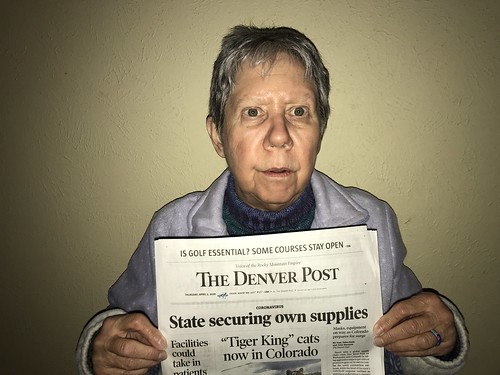
The Spousal Unit and I are really fortunate: a four bedroom tri-level in a semi-rural neighborhood near Denver Colorado. But even then, we get our share of cabin fever. If we were stuck together in a tiny house, we'd be posting photographs of us holding the daily newspaper just to prove we hadn't killed each other.

IMG_3933

(I'm not the only one thinking about this: "Homes Actually Need To Be Practical Now" and "Trapped at Home With People You Met On Craigslist", both in my favorite magazine, The Atlantic.)

Wednesday, January 23, 2019

Nothing Is Ever Simple (January 2019 Edition)

I recently discovered, completely by accident, that some of the photographs in my blog were not displaying. It's an issue somewhere along the pipeline with the Safari browser on my Mac (which ultimately renders the embed HTML), Google's Blogger (which has hosted my blog since 2006), and Flickr (which has hosted my photographs since 2004). The embed HTML that serves up the photograph is, these days, provided directly by Flickr; but Blogger also provides a image embed button, and that may well be what I used in the dim past.

So far I've only found two broken articles
DTMF Tones, Fourier Transforms, and Spectral Analysis
and
Ahoy-hoy!
among the 290 that I have written. I believe I've fixed both of them.

These two related articles were written about the same time, February and March of 2014. The embed HTML in both articles that references photographs uses the iframe HTML tag. Articles in my blog written before and after that reference photographs do not use iframe, and seem to render okay. 

Some judicious web searching led me to some discussions amongst Flickr users as to the iframe embed code no longer being supported by Flickr. My current thinking is that that at some point Blogger generated the iframe HTML tag to embed images, and Flickr eventually declined to support it.

Thanks, Cloud.

If you come across an article in my blog that has a big block of white space where you think an image ought to be, please comment on that article and I'll do my best to fix it.

Wednesday, April 25, 2018

How do we do it? Volume.

Here's another fun exercise from this evening class on the science, nature, and philosophy of time that I'm taking. (The instructor attributes this to Nobel prize winning physicist Kip Thorne's 1994 book Black Holes & Time Warps.)

Get three meter sticks: that's a measuring stick like a yard stick, but it's one meter long, it's divided up into one hundred centimeters, and every centimeter is divided up into ten millimeters.

Lay the first stick down on the table. There are one thousand (1,000 or 103) linear millimeters along the length defined by that stick.

Lay the second stick down on the table at a ninety degree angle to the first so that their corners touch. There are one million (1,000,000 or 106) square millimeters in the area bordered by those two sticks.

Lay the third stick orthogonally so that it stands straight up from the table and its corner touches the corners of the first two sticks. There are one billion (1,000,000,000 or 109) cubic millimeters in the volume bordered by those three sticks.

See, you thought a billion was big, didn't you? But here we are, with a billion easily measurable things just in the space on the table right in front of us.

(I was forced - FORCED, I tell you - to order three inexpensive wooden meter sticks from Amazon just so I can do this in real-life.)

Monday, October 30, 2017

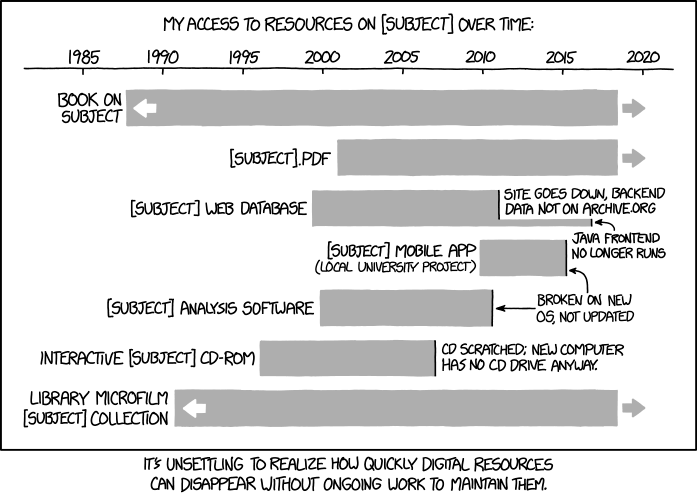
xkcd: Digital Resource Lifespan

Today's excellent (as usual) xkcd cartoon by Randall Munroe reminds us of the ephemerality of digital information.


Once again, this being a topic I have raised over and over in this blog, I'd like to mention that the definitive work on this topic is
Jeff Rothenberg, "Ensuring the Longevity of Digital Documents", Scientific American, vol. 272, no. 1, January 1995 .
A digital copy of Rothenberg's article can, at least at the moment, be found at
https://www.clir.org/pubs/archives/ensuring.pdf .
It's well worth reading. And appropriately terrifying, given the season.

It's not just the digital media itself that has a (sometimes remarkably short) lifespan, but also the technology - both hardware and software - to read the media, and even the specifications that describe the format and encoding of the media. I've seen a vase from ancient Greece inscribed with art and symbols that are perfectly legible millennia later. I've been up close to a first edition of a book written by Galileo in the early 18th century. We can still read the letters John Adams and his wife Abagail wrote to one another during the time of the American war of independence. I have CD-ROMs that are just a few years old which are no longer usable. And trying to read the eight-inch floppy disks for the CP/M file system that have the text of my master's thesis in WordStar format? Good luck. (The thirty-four year old hardbound version on acid-free paper is completely legible.)

The only way to insure the longevity of digital information is to continuously refresh it onto new media using current technology. This becomes less and less practical as the amount of digital information continues to grow an a rate that can only be described as alarming.

Saturday, October 21, 2017

Thought Experiment

A long long time ago, in a university far far away, I was thinking about how the classic ring-shaped rotating Von Braun space station, like the one with the Hilton hotel in the movie 2001: A Space Odyssey, uses centrifugal forces to simulate gravity. I began to wonder: if you took that space station way way out into deep space, presumably its occupants would still feel pushed towards the floor that was the outer portion of the ring. But if they looked out the window, there is no way they could tell relative to what they were rotating. In fact, other than the fact they could still sip coffee out of open-topped mugs, they couldn't tell they were rotating at all, visually.

(image credit: Wikimedia)

When faced with such conundrums, I did what I always did at the time, I asked my friend and colleague David Hemmendinger. David and I were both graduate students in computer science at the time. But while I had a freshly minted bachelors degree in CS, David already had a Ph.D. in philosophy. At the time he was the smartest guy I knew. (He may still be the smartest guy I know. But in the more than three decades hence, I've continued my habit of working with people a lot smarter than I am, so it's not a given.)

Dave explained that this was a question that troubled lots of people. He told me about Mach's Principle - the same Mach as in Mach Numbers, for describing supersonic speeds. Mach proposed that the rotation that results in centripetal force is relative to absolute space (take that, Relativity!). It's the same principle that causes gimbaled gyroscopes to try to maintain their orientation as they spin no matter how you move and rotate them; they are trying to remain in the same position relative to the entire mass of the universe.

Seriously?

That sounded pretty darn fishy to me. I'd had several physics courses as an undergraduate and knew the math behind Relativity well enough. I understood that rotation was a form of acceleration, and that accelerated inertial reference frames were different from unaccelerated inertial frames of reference.

But how exactly does the distant mass in the universe affect the gyroscope on my desk? Apparently instantaneously? I didn't buy it. I could tell from Dave's clouded expression and half smile that he didn't quite buy it either. He made it clear that he was just reporting what he had read.

This question stayed with me for the next thirty-plus years. I just figured I was kinda stupid, and that someday I would come across the answer.

So this morning I read Tony Rothman's article in American Scientist, "The Forgotten Mystery of Inertia".
https://www.americanscientist.org/article/the-forgotten-mystery-of-inertia
It's not long. And it's an easy read. Here's is what I learned.

No one understands this.

This same basic thought experiment troubled Newton, Einstein, Mach, Gödel, and lots of physicists and philosophers right up into the present day.

Everyone knows the what of inertia; the math we use to describe it is completely accessible. But no one can explain the how.

How do rotating space stations simulate gravity? How do gyroscopes strive maintain their original orientation - RELATIVE TO WHAT, FOR CROM'S SAKE?!?!?!? - once they start spinning, and do so with such reliability that we use them inside gyrocompasses as part of inertial navigation systems in everything from nuclear submarines to intercontinental ballistic missiles?

I'm not stupid. (Well, not because of this, anyway.)

The world we live in is. Just. That. Weird.
"If you don't find reality fascinating, you just aren't paying attention." - Me, often.

Saturday, March 19, 2016

A Rambling Rant by an Old Man

I have had a good deal of career success. I attribute that success to a lot of things. One of those things is being evidence-based. Don't guess. Test. Measure. Look and see. Ask. If you can avoid guessing, do so. Sure, there are times you have to make a decision with incomplete information. But a lot of the time you can either defer that decision until more information is available, or improve the information on which you base your decision.

Not all opinions have the same value. For example, I have worked with people who have shared in a Nobel prize for their work in climate physics. Their opinions on climate change carry a lot more weight than yours. When you offer an opinion, on climate change or any other topic, I am going to assign an information content score to what you say. The definition of information is data that reduces uncertainty. The score I assign to your opinion might be zero.

The older I get, the more I seek out the original research and data on which people base their opinions. Often they either heard something second hand, third hand, or N-hand -- this is the "Chinese Whispers" problem -- or maybe the original study was flawed or biased, or maybe they are just full of crap because they believe what they want to believe. Most of the postings on Facebook fall into this latter category.

I like to read stuff that reinforces my opinions. I have read articles suggesting that this is common. I also like to read stuff that challenges my assumptions. I have read articles suggesting that this is rare. But it's the stuff that challenges my assumptions -- like education is a universal good, or that better communication unambiguously improves life -- that I find the most useful, and, really, the most interesting.

I like to read fiction, and have done so for decades. But increasingly I find myself more drawn to reading non-fiction. I find reality to be a lot more interesting, and stranger, and more compelling, than most of the fiction I read. It's as if reality exists just to entertain me. If you don't think reality is a damned interesting thing, then you aren't paying attention.

I'm old. Really old. I'm at an age where I have to read the obituaries, not just to make sure I'm not listed, but because I've lost many close friends and valued colleagues to accidents, strokes, cancer, heart disease, suicide, and even murder. I have a strong sense of my own mortality, and that time is short. Here's the thing: it's short for all of us, regardless of age. So you'll have to excuse me if I just don't have time for your bullshit.

I like people that agree with me. I also like people that don't agree with me. And I really like people for whom, when they don't agree with me, there is at least an even chance that they are right and I am wrong.

I find that, generally speaking, people act in the way in which they are incentivized to act. So if people aren't acting the way you want them to act, you should examine their incentives. Often, you will be the one (mis-)incentivizing them.

It's becoming increasingly difficult to find a really good soft pretzel.

Friday, March 11, 2016

How do you get to Carnegie Hall?

So I told him the same thing I tell all of them.

It's taken me forty years to get where I am. Two college degrees. Long periods of not making much money but getting a lot of great experience. Mentoring by many generous people smarter than I am. A lot of hard work. Many late nights and more than a few weekends. Even a skipped vacation or two. Occasional good judgement. Some luck. It helps a lot that I love what I do so much that I do it even when I'm not getting paid for it. There could be a faster way to get here, but you're asking the wrong guy what it is.

This is never a popular answer.

(Thanks to my friend and colleague Doug Young for suggesting the title.)

Friday, April 03, 2015

Altered Finite States

Folks who have spent time in a flotation tank report that their first experience consisted mainly of figuring out just how the heck to use a flotation tank. Having now had two one-hour sessions in a flotation tank myself, I can confirm that this is accurate.

I-sopod Flotation Tank
Photograph: Wikimedia

Flotation tanks, also known as isolation tanks, and occasionally as sensory deprivation tanks, are these days large horizontal enclosed tubs filled with a few inches of water containing a very high concentration of dissolved epsom salts (magnesium sulfate). The resulting solution is so dense that you can’t help but float when you lie down in it. The solution in the flotation tank is heated to body temperature, sanitized, and continuously filtered. The solution does not taste salty; it tastes vile (take my word on this).


Flotation therapy is used for a variety of purposes ranging from relaxation, meditation, or (if you’re like me) because you’ve seen the movie Altered States or the television show Fringe. I am happy to report that I neither regressed to a neanderthal, nor did I emerge from the tank in a parallel universe. As far as I can tell, anyway. I did warn Mrs. Overclock ahead of time that she might get a phone call in the event I woke up naked in the Denver zoo.

March: The First Session

For my first session, I attended a local spa called A New Spirit. Yeah, I know. It was full of New Age music, gently falling water, and the smell of incense, just as you might imagine. Being an engineer, I would have been happier if it had been all stainless steel and the employees wore lab coats and carried clipboards. But what really surprised me was that it wasn’t until I completed my session and was ready to leave that I saw a woman who wasn’t an employee; up until then, all of the customers I saw sitting around wearing the terry cloth robes provided by the spa were men, some of whom were waiting their turn in one of the three flotation tanks.

Each tank was in a private room. I showered in one of the two bathrooms to remove surface dirt and oil from my skin. I stored all of my personal effects in the provided tote bag, put on the bath robe, entered the tank room that had been assigned to me, and closed the door. I hung up my robe, inserted the disposable foam earplugs provided by the spa, and, naked as the day I was born (but a lot fatter and hairier), I opened the hatch at the front of the tank and climbed in.

All three of the flotation tanks at this spa were of similar size, but this one had a hinged hatch at one end, while the other two tanks (which I peeked at when they weren’t being used) had sliding hatches in their mid-sections. The tank appeared to be fiberglass, in top and bottom halves. The bottom half had a water tight liner in it. Both the solution and the air inside the tank were heated to body temperature. I knelt down into the solution, closed the hatch, and laid down.

I spent the next hour trying, mostly unsuccessfully, to relax. At first I couldn’t see or hear anything. But gradually I became dimly aware of the New Age music, which didn’t seem that loud even outside of the tank room, but managed to permeate both the ear plugs and my tinnitus. Eventually the music became dominated by the sound of my pulse in my ears, and, after a bit, the noise of water trickling past the earplug in my left ear. This latter sound came to seem as loud as  the rushing torrent of a stream in the mountains in the spring.

As my eyes became adjusted to the dark, I because aware of a ring of light around the seam between the top and bottom halves of the tank. That’s kind of remarkable, since the tank room itself was very dimly lit. But unless I turned my head to either side, I couldn’t really see this band of light, nor did it illuminate the interior of the tank enough to actually make out any detail.

I went through the (apparently common) issue of where to put my arms: down at my sides, up above my head, somewhere in between. I felt compelled to explore my surroundings. I’m of average height and I found that if I stretched my legs down and my arms up above my head, I could just barely touch the far ends of the tank. The tank was proportionately narrower, so that I could touch either side without extending my arms very much at all. As I tried to relax and float, I drifted around in the tank, occasionally bumping into the sides.

The spa provided one of those foam "swim noodle" tubular pool toys to use as a sort of pillow, and I had to experiment with that as well: use it, don’t use it, put it under my neck, beneath my head, etc. The spa web site mentioned that some people find sitting up in the tank more comfortable. I tried that, only to discover that the heating elements for the water were below the floor, making my bum uncomfortably warm. Being an old guy, my arms and legs would stiffen up and become uncomfortable, so I had to flex them from time to time, which caused the water to slosh around, which caused me to repeatedly bump into the sides of the tank.

After a loooooooooong subjective period of time, an attendant entered the room, knocked on the outside of the tank to let me know my hour was up, and then left. (They ask that you knock back so that they know you aren’t asleep, or dead, or in a parallel universe, and I did that.) I got out of the tank, dried off, and put my robe on. I left the room, took another shower to wash the epsom salts off, got dressed, paid, and left.

First impression: it was interesting. But I spent most of my hour flailing around. I really needed to try it again.

April: The Second Session

I changed a few things for my second flotation session at A New Spirit. I bought some disposable silicon swimmer’s earplugs that I hoped would do a better job of keeping the solution out of my ears. (They did, but didn’t do any better in blocking out the New Age music.) I took a shower before I left the house to save a little time at the spa. Other than that, this visit started out much the same as the first one. I was even assigned the same tank room.

But this time I spent less time figuring out what to do and just tried to relax. I did better this time. I still had to flex my stiffened arms and legs occasionally. I found that I was the most comfortable with my arms in a “hands up, don’t shoot” posture, below the foam float that I still used behind my head, and sometimes with my hands lightly clasped. I was able to concentrate more on my breathing and less on my no longer so strange environment. I had less tension in my neck and back. All things considered, the second session went a lot better. I had some quality thinking time.

What did I think about? Being a typical male, sex, every few minutes. Sometimes with Blair Brown. But mostly I thought about socket multiplexing.

No, really.

I’ve been working on some open source Linux/GNU-based socket handling code based on work I did under SunOS way back around 1989. (This is part of my Diminuto C-based library you can find on GitHub.)  I had wanted to do some refactoring of the socket multiplexing unit test, which is a simple running example of a single-threaded service provider. I worked out all the details while in the tank. Once I got back to my office at home, I completed what I had originally estimated to be a day’s work in a couple of hours. I also fit in lunch at the local deli on my way home from the spa, and a trip to the gym late in the afternoon to lift weights. I call that a good day.

Future Sessions

I’m going to keep up monthly sessions in the flotation tanks at A New Spirit for a while. It’s part of my effort to learn to relax, to try to reduce my addiction to constant mental stimulation, to increase my attention span, and improve my ability to get into the zone. I’m also going to work on learning to meditate. All of this in an effort to think deeper thoughts, to gain better insights, and to enhance my ability to think longer term, by at least temporarily removing the more or less trivial distractions that are ubiquitous in today's world.

Or maybe I just like lying around buck naked.

Friday, March 13, 2015

Finding the Door into Summer

Not being much of a fantasy reader, I wasn't a fan of Terry Pratchett's fiction, although I did develop a lot of affection for the man from the times I've seen him on panels and such at science fiction conventions (SF fans being like the ancient Greeks in that our gods walk among us and occasionally meddle in our affairs). Nor am I a huge fan of the late Robert Heinlein, although unlike Pratchett I did read a lot of his books in my youth. But the recent death of the former -- at an age not all that much greater than mine -- got me thinking about the latter.


In Heinlein's 1956 novel The Door Into Summer, the book begins with the protagonist renting a rural farmhouse and living with a cat named Petronius, indeed the very same after which my own feline overlord Petronius is named.


Petronius Sloan


Typical of many rural buildings, the house had been added to over the years such that it had an unusual number of doors leading outside. And like many cats, Petronius was constantly demanding to go outside, even in the dead of winter. The cat insisted on exploring all the doors, all the time, and the hero of the story remarked that Petronius was looking for the "door into summer", the door that lead to the grassy meadow full of butterflies that it remembered from the prior season. (SPOILER ALERT) So at the end of the book when Petronius dies of old age after a long and happy life, the hero says that his beloved cat finally found that door he had been looking for.

I liked that metaphor very much. When it is my time to have that final stroll with Death, I hope my friends say "Chip finally found the door into summer".

Tuesday, February 03, 2015

The More Things Change, The More They Change

Stick a fork in RadioShack because it's done, reports Bloomberg. 


How a chain founded on selling parts from the then new-fangled electronics industry can up and die in the midst of the biggest DIY high-tech "maker" movement in history is almost beyond me. But besides competition from the Internet and the difficulty in stocking inventory for the "long tail", I have a sneaking suspicion this is yet another example of short term optimization -- "Let's sell phones, it'll be a lot cheaper and easier, and everybody loves phones!" -- over long term optimization -- "Let's sell complex electronic components and kits at low margins and that require knowledgeable sales people".

I used to routinely buy electronic parts at the Shack at our local outlet mall -- "I need some 120 ohm resistors to terminate a CAN bus." -- where I dealt with an old guy (older than me!) who was clearly retired from one of the Denver area's high-tech manufacturers and who was always interested in what I was working on. "Bring it in, I'd like to see it!" he'd tell me. Wish I knew where he moved on to. But I'm part of the problem, not the solution. Me, I'm the guy that bought an oscilloscope off Amazon.com.

On the plus side, at the coffee shop yesterday morning a college-age guy sitting at the same communal table out of the blue asked me if I was familiar with the programming language Haskell. "Is that the one that's purely functional?" I asked, which was all that was necessary for us to nerd bond. In his defense, I was reading an IEEE book written by a capital theorist that was an economic analysis of the software development process. So he might have had a clue that we were of the same tribe.

It is both the end, and the beginning, of an era. Just like always

Monday, March 03, 2014

Ahoy-hoy!

Little did I know when I wrote a little bit of telephone dialing history in DTMF Tones, Fourier Transforms, and Spectral Analysis that just a few days later I would be living it. (If you're into this sort of thing, I just updated that original article with photographs of vintage telephones from my personal collection for illustrative purposes. Doesn't everyone have a collection of vintage telephones?)

Mrs. Overclock and I recently paid a visit to Tucson Arizona to spend time with family on the eve of our thirtieth wedding anniversary. We spent a couple of nights at the downtown Hotel Congress, built in 1919 and best known historically as having played a role in the capture of the notorious John Dillinger in 1934.

One of the first things I noticed when we entered our room was the the rotary dial phone.

Untitled

The rotary dial room phones were in turn connected to a manual telephone switchboard stationed behind the reception desk in the main lobby. (This photograph is actually of one of the two additional inactive manual switchboards on display in the hotel lobby.) Notice the switchboard also has a rotary dial.

Untitled

Here's a close up of the tip-and-ring connectors one of those switchboards. As you can see, they are almost identical to the "phone plug" shown in my original article and which I purchased at my local Radio Shack, intended for applications like quarter-inch stereo headphone jacks.

Untitled

As I've said before, telephony technologies tend to be long lived. This is partly due to the network effect: the more people that were able to connect using a technology, the more useful and hence the more valueable it was. This was frequently an issue for telecom developers of yore as they discovered that customers expected to amortize their telecommunications equipment purchases over a decade or more. Hence, telephony equipment -- both hardware and software -- was typically built to last.

Monday, May 06, 2013

In It For the Long Run

Poster Child for Obsolete Computer Skills

Journalist Brian Hall interviews me on what it's like to be the poster child for not letting your tech skills become obsolete in How to Thrive In The Tech Industry For Decades.

Saturday, May 04, 2013

I've become an internet meme!

LinkedIn Front Page 2013-05-04

I brought up LinkedIn in my browser this morning and this is what greeted me: a photograph of me taken circa 1978 has ended up in an article on obsolete technology skills. Amused friends and colleagues continue to pass this link on to me. The first to do so worked at that very same computer center at Wright State University when that photograph was taken. That's an IBM 360/65 running OS/MFT in the background, on which I worked as a systems programmer while in college. I dimly recall that it had a whopping 256KB of memory. I am totally rocking that 1970s look.

Engage the Ironic Drive, Mr. Crusher!