Showing posts with label C++. Show all posts

Monday, April 08, 2024

Ancient History

I bought a four terabyte (4TB) SSD the other day at the local big box store. A Samsung T7 Shield (which I think just means it comes with a rubberlike case around it). It was substantially discounted, probably because the new T9 model is out. Easily fits in my shirt pocket. Hooked it up via the included USB cable to our network-attached storage box, and I'm now using it to automatically back up two Mac laptops and a Mac desktop at the Palatial Overclock Estate.

Mind blown.

Because I am ancient almost beyond belief - it's a miracle I'm still alive, especially considering my hobbies - I remember thirty years ago helping to write a proposal to DARPA to build a one terabyte (1TB) hierarchical storage system that would have included rotating disks and a robotic tape library. It would have taken up an entire room. Can't blame them for not funding it. Someone smarter than me (which could have been just about anyone) probably saw this all coming.

That same organization, the National Center for Atmospheric Research (NCAR) in Boulder Colorado, had the only CRAY-3 supercomputer outside of Seymour Cray's Cray Computer Corporation. Today, your Raspberry Pi Single Board Computer (SBC) - and not even the latest Pi model 5 - has more horsepower than that CRAY-3. And the SBC would fit in your shirt pocket as well.

Don't bet against Moore's Law.

Although as I am always quick to point out, what exactly Moore's Law implies has changed over the past few years. Which is why I was tickled when someone who is using my Diminuto C systems programming library passed along a command line to build the software by running make across sixteen parallel threads of execution - taking advantage of the trend towards multicore processors, now that it's become difficult to make individual processors faster. Between much of the build process being I/O bound, and having four processor cores on the Raspberry Pi 5, this approach really speeds up the makefile.

CRAY-3

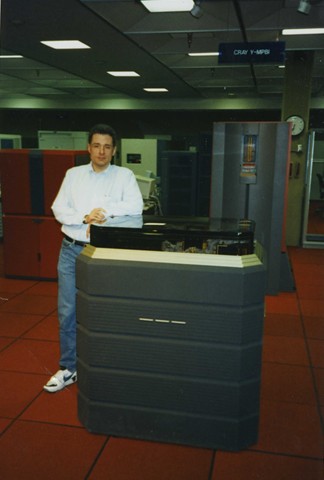
That's me, about thirty years ago, leaning against the world's most expensive aquarium; the CRAY-3 logic modules were visible under the transparent top, fully immersed in Fluorinert.

Wednesday, March 20, 2024

Converting GPIO from the legacy sysfs ABI to the ioctl ABI in Diminuto and Hazer

It could be that no one but me is using my "Hazer" GNSS library and toolkit, or the "Diminuto" C-based systems programming library on which it depends. But just in case: I'm close to finishing testing of the develop branch of both repos, both of which have some major changes to how General Purpose Input/Output (GPIO) - the generic term for controlling digital input and output pins in software - and merging develop back into the master branch.

This was all motivated by my being one of the lucky few to get a backordered Raspberry Pi 5, and putting the latest version of Raspberry Pi OS, based on Debian "bookworm" and Linux 6.1, on it, only to find when unit and functional testing my code that the deprecated sysfs-based GPIO ABI no long worked. This wasn't a big surprise - I had read at least two years ago that the old ABI was being phased out in favor of a new ioctl-based ABI. My code makes heavy use of GPIO for a lot of my stuff, e.g. interrupts from real-time sensors, the One Pulse Per Second (1PPS) signal from GNSS receivers, status LEDS, etc. So it was finally time to bite the bullet and replace all the places where I used the sysfs-based Diminuto Pin feature (diminuto_pin) with a new ABI using the ioctl. Hence, the Diminuto Line (borrowing a term from the new ABI) feature (diminuto_line).

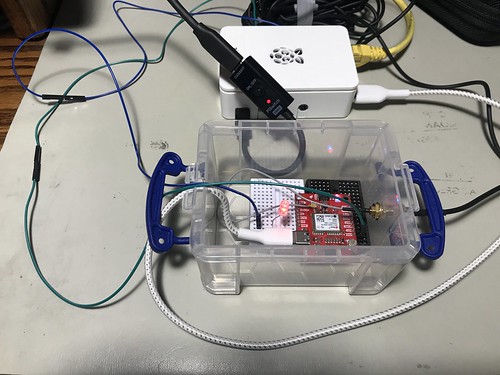
Line is now used in place of Pin in all of the Diminuto functional tests that run on  hardware test fixtures I wired up many years ago just for this purpose, and all the functional tests work. The Hazer gpstool utility has similarly been converted to using Line instead of Pin and has been tested with an Ardusimple board using a u-blox UBX-NEO-F10T GNSS receiver.

IMG_5717

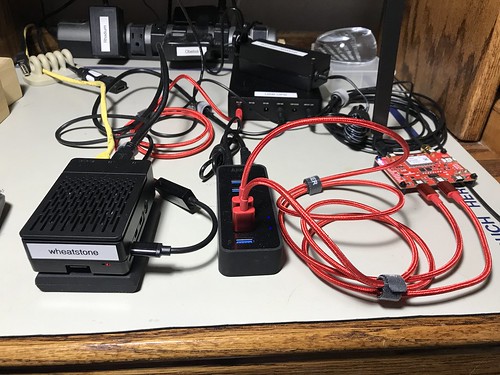
(That's a Pi4 on the left connected to my test fixture, and a Pi5 on the right connected to the GNSS receiver.)

Two complaints.

[1] The new ABI is woefully under documented. However, I found some code examples in the Linux kernel source repo under tools/gpio that were essential to my understanding. (I chose not to use the new-ish libgpiod for my work, for reasons, but that is a story for another time. I have no reason to believe that it's not perfectly fine to use.)

[2] The way the ioctl GPIO driver is implemented on older versus newer Raspberry Pi OS versions makes it difficult - I am tempted to say impossible, but maybe I'm just not that smart - to write code that easily runs on either platform using the new ABI. Specifically, the GPIO device drivers in the OSes use a different symbolic naming scheme, making it impossible for application code to select the correct GPIO device and line offset portably on the two platforms. But maybe I'm just missing something. (I hope so.)

I like the new ioctl ABI, and expect to use it exclusively moving forward, even though this will orphan Pis I have that might run older versions of the OS. (I think I have at least one example of every Pi version ever sitting around the Palatial Overclock Estate. Ten of them run 24x7 in roles such as a web server, an Open Street Map server, a Differential GNSS base station, and an NTP server with a cesium atomic clock for holdover.) I have tagged the last version of both repos that still use the sysfs ABI.

That's it.

Update (2024-03-23)

I merged the develop branch in to the master branch this morning. Both the Diminuto build and the Hazer build passed sanity and functional testing (and I'm currently running the long-running "geologic" unit test suite against Diminuto). I had tagged the old master branch in both repos with the name sysfsgpio in case I needed to build them, but I don't anticipate any further development of the old code.

Friday, January 05, 2024

Right to Repair, Polish Train Hackers, and the NSA's Ghidra

Google "Polish train hackers" and you'll find dozens of articles in the tech press about this story. Here is the link to the one I read, which was translated from the original Polish. It's terrific. Compelling reading if you're interested in the misuse of Digital Rights Management or the Right To Repair movement. Or if you're into embedded systems development and troubleshooting. Or just if you're into stories of heroic efforts by engineers.


Polish embedded systems hackers use (get this) the U.S. National Security Agency's open source Ghidra tool, originally intended to reverse engineer binaries of computer viruses and other malware, to figure out why high-tech passenger trains, like in the video above, quit working after undergoing routine maintenance - following the train manufacturer's own two thousand page maintenance manual - by a third-party.

What did they discover in various versions of the train software/firmware?

  • Odometer checks that prevent a train from running after a million miles.
  • Year, month, and day checks that prevent a train from running after a certain date.
  • Geofencing checks (naturally the trains have GNSS receivers) that prevent a train from running if it is within the boundaries of a competitor's maintenance depot.

I've used Ghidra myself, and written about it in my blog. The tool includes not just a disassembler similar to objdump, but also a remarkable decompiler that can translate machine code using common C compiler idioms and patterns back into C code. Ghidra understands a wide variety of Instruction Set Architectures. Just recently I've been using it to study the binaries of my own code compiled for a RISC-V target.

DRM and Right To Repair is a big deal in the U.S., Manufacturers of agricultural equipment, like farm tractors costing six figures, have resorted to similar shenanigans to prevent even the farmers who own the equipment from repairing their own stuff. So much so that Right To Repair legislation is coming to the forefront of both state and federal legislators.

Monday, July 03, 2023

Hazer with the U-blox NEO-F10T GNSS Receiver on the Ardusimple SimpleGNSS Board

It's been a while since I talked about my GPS/GNSS efforts. Some time ago I bought a SimpleGNSS board from Ardusimple to try out. The SimpleGNSS has the new U-blox NEO-F10T GNSS receiver. This was my first experience using a new U-blox generation 10 device. It is the first GNSS device of any kind I've used that includes features specific to the latest version 4.11 of the National Marine Electronics Association 0183 standard. And it's the first I've used that's capable of receiving the new L5 band signal from the latest Block III GPS satellites.

I was about ready to dismantle this experiment. But before I removed it from my workbench, I thought I'd update y'all on my latest version of the Hazer library and its gpstool utility.

Hazer is a Linux/GNU/C-based library that supports the processing not only of the usual NMEA 0183 output of GNSS receivers, but also proprietary binary output like UBX from U-blox devices, and CPO output from Garmin devices. It also handles input and output of RTCM messages in support of differential GNSS, yielding geolocation precision down to about a 1.5 centimeters. (I run a DGNSS fixed base and a stationary rover 24x7 at the Palatial Overclock Estate.)

gpstool is the Swiss Army Knife of Hazer. It's one of those old-school tools that has a nightmare of command line options. I use it to functionally test the library, and also as the main component of most of my GNSS efforts. You wouldn't want to use gpstool to navigate cross-country (although I have used it in conjunction with OpenStreetMap to generate a moving map display in real-time). But I find it really useful for testing and evaluating new GNSS devices and just generally futzing around with geolocation and precision timing.

(You may want to click on the short video clips to view them on YouTube instead of from this blog; the UI seems to crop the images, losing some information. You can also click on photographs to see a larger image.)

Here is a short video clip of a Raspberry Pi 4B running gpstool with the NEO-F10T connected via USB.

Besides processing the output of the U-blox device, gpstool is following the 1 Hz One Pulse Per Second (1PPS) digital output signal from the device, which is syntonized to GPS time, and strobes another digital line on the Raspberry PI, syntonized to 1PPS (subject to software latency), to which I've attached a red LED.

Here is a short screen capture that shows the output from gpstool. I've SSHed into the Raspberry Pi from my Mac desktop to run gpstool. The utility uses some simple ANSI screen controls to update the display in real-time. I'm viewing standard output directly from gpstool, but the utility also has the ability to run headless in the background as a daemon, and you can view this real-time display remotely at leisure. (This is how I run my DGNSS systems.)

If you have perused the output of gpstool in any of my prior articles, you may notice a new field in the SAT lines showing the frequency band used by the device to receive data from the indicated satellite, e.g. L1 C/A. Some GNSS devices (like this one) may receive data from the same satellite over more than one band. (I confess this "new feature" is a long delayed bug fix because I botched the handling of new fields in version 4.10 of the NMEA 0183 spec. I have no excuse.)

gpstool isn't just a passive monitor. You can use its command line options to send NMEA, UBX, and other message formats to the device to interrogate and configure it. I did this with the NEO-F10T. Here is a screen shot of a snippet of a script similar to the one I used to generate the output shown in this article.  It sends a batch of UBX messages, sequentially, waiting for an acknowledgement for most of them, to configure the device.

Screen Shot 2023-07-06 at 13.28.38

You can find this script in its entirety in the Hazer repository on GitHub.

Finally, in addition to the standard output, gpstool generates log output on standard error, which here I capture in a file. (If you run gpstool headless, log output can also be automatically directed to the system log without any need for a command line option or API call.)

Hazer gpstool Example Log File

In this example, I have the log output level set to INFO (informational) and above; setting it to the DBUG (debug) level and above generates more output than I typically need unless I am actually debugging new code. (The logging system is a feature of Diminuto, my Linux/GNU/C-based systems programming library on which Hazer and gpstool are built; Diminuto has its own ginormous feature set.)

That's a quick update of some of my latest poking around with GNSS. I'm always on the lookout for new (to me, anyway) GNSS devices to play with!

Wednesday, June 07, 2023

Bug Blast from the Past

I found a Day One bug in some unit test code today that I wrote in 2014, nine years ago. What caused the bug to show up now? I had botched where I had put a thread scheduling yield function call relative to a critical section in the unit test. Apparently this is the first time I have ported this multi-threaded C code to a single-core processor - in this instance, a Raspberry Pi Zero

This is remarkable. As someone said when I related this story to them, it's not uncommon to uncover bugs in code being ported from single core to multi-core processors, but the opposite transition happens seldom enough that this kind of event is rare.

For most of my career - which began before microprocessors even existed - all such computer chips were single core, that is: capable of executing only a single machine instruction at a time. I started writing this library, Diminuto, for a single core ARM4 processor in 2008. But it didn't take long to migrate to inexpensive ARM and Intel chips that could execute more than one instruction at a time. Today, I routinely use small development and test machines that have four or even eight processor cores. As a former colleague of mine, who I met when I worked in Boulder at the National Center for Atmospheric Research and he with Seymour Cray at Cray Computer Company in Colorado Springs, once remarked, your Raspberry Pi 4B single board computer can, by most metrics, outperform Seymour's last supercomputer, the Cray-3 a.k.a. "The Fish Bowl".

The evolution of multi-core microprocessors was largely motivated by, IMNSHO, the end of Moore's Law, at which point doing stuff in parallel was the only way to produce faster microprocessors... faster, at least, for those applications which could take advantage of them. See also: Amdahl's Law.

CRAY-3

Yes, that's a young(er) iteration of me leaning on a Cray-3 in NCAR's computer room at their Mesa Laboratory in Boulder Colorado. Compared to what we can do with computers today, those were the old days, but not necessarily the good old days.

Thursday, February 03, 2022

Revisiting the First-Come First-Served Reader-Writer Solution

In "First-Come First-Served Readers and Writers in C using Monitors", I wrote about my solution to the classic Readers-Writers concurrency problem, in C using POSIX threads. My solution maintained the multiple-reader/single-writer invariants, but enforced access to the shared resource (whatever it was) in strict time order: readers could access the shared resource concurrently providing a writer had not requested accesses ahead of them. While POSIX threads provides its own Readers-Writers lock solution - see pthread_rwlock_rdlock(3) and pthread_rwlock_wrlock(3) - strict time ordering is not necessarily guaranteed.

My diminuto_readerwriter code, part of my Diminuto C-based systems programming library that I've been maintaining and expanding since 2008, worked fine for what I needed at the time. But it had one flaw that prayed on my mind: it required that the application provide an array that the algorithm could use in which to store state. This wasn't a big deal, except that sizing the array was sometimes not straightforward. And it just seemed awkward. Since I was thinking of using the Reader Writer code for another purpose, I finally decided to fix that.

I replaced the array - what the API referred to as the ring buffer - with a diminuto_list (or just List), a doubly-linked-list structure provided by the library, for what the API now refers to as the wait list. The root of the List was part of the structure that defined the diminuto_readerwriter (or just Reader Writer) lock object. Each thread now has a List node that is automatically dynamically allocated on first use and stored in the thread's thread-local storage (see pthread_key_create(3)), and is automatically freed when the thread exits. No matter how many Reader Writer locks you use, you only needed one List node per thread, because a thread can only block on one Reader Writer lock at a time.

This worked out really well. All of the storage management of the wait list was completely under the hood and handled automatically. The application didn't have to worry about sizing anything. And the wait list offered some additional useful capabilities.

It greatly simplified the implementation of timeouts, where a thread could get an error return from its Reader Writer request if it could not be serviced within a specified time interval. This was especially useful in some niche applications in which a timeout of zero is used to poll for resource availability.

It also made it easier to implement priority, or expedited, requests, in which the blocking thread is pushed onto the front of the wait list instead of queued at its end. This allows applications to, for example, give a specific writer priority over readers and other writers. This is useful for real-time events, like the loss of a socket connection, to cancel pending transactions and possibly take corrective action ahead of waiting readers and writers.

But what I really liked about this refactoring of my Reader Writer solution is that it reminded me of how much I like using Diminuto's implementation of Lists. Because it's an implementation that doesn't use null pointers.

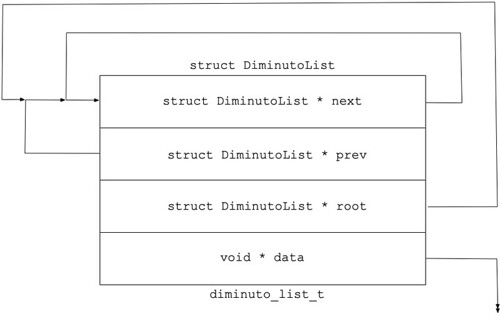
A Diminuto List node consists of four pointer fields: next, prev, root (all of which point to a node) and data (a generic void pointer). (As usual, you can click on an image to see a larger version.)

diminuto_list_t

The next and prev field are obvious: they are the pointers that actually implement the doubly-linked-List. One of the advantages of a doubly-linked-list is that a node can be removed from a List by starting with just a pointer to the node; no other information is necessary to link the prev node with the next node and making the List whole again. Similarly, you can insert a new node into a List using just a pointer to the new node and a pointer a node that is already on the List; the new node can be easily added before or after the existing node.

The root field points to the root of the list; this allows the application to identify what List any node is on. When a new node is inserted onto a List, it automatically inherits the root of the node that is already on the list.

Here's the interesting part: when a node is initialized, its next, prev, and root pointers are all set to point to itself. No null pointers (except perhaps for the data pointer; we'll get to that in a bit). All List nodes start out life as a List of one node, serving as their own root.

InitializedNode

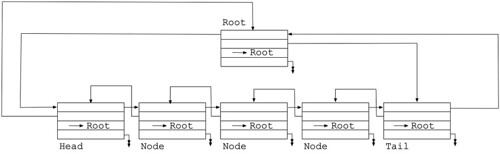
The root of the list - the node that is used to represent the List itself - starts out life like this: with its root pointer pointing to itself. As new nodes are queued to the end of the List or pushed onto the front of the List, they inherit the root pointer of the root node. Traverse the list in either direction and you come back to the root node. You know it is the root node, because its root pointer points to itself. You know if a List is empty if the next and prev pointers of the root node point to itself. This also makes is trivial to access the head or the tail of a List.

Thus, the Diminuto List isn't just a doubly-linked-list, it is a circular-doubly-linked-list. 

FiveNodes

There is a simple iterative mechanism in the List API to re-root a list so that some other node represents the List. This works because there is no difference between the root node and any other node on the List. 

Except - maybe - the data pointer.

The data pointer is for whatever the application wants to use it for. None of the List implementation implicitly reads or modifies the data field of a node. The List node initialization function doesn't touch the data pointer. Typical applications using a Diminuto List use the data pointer to contain application data (or a pointer to such), or a pointer to the structure in which the List node structure itself is embedded.

The Reader Writer object uses the latter technique: it has embedded in it a List node structure used as the root of the wait list, and the data pointer in that single List node is set to point to the Reader Writer object itself. This allows any thread on the wait list to trivially access the Reader Writer object on which it is waiting by [1] accessing the pointer to its own List node in its thread-local storage, [2] going through the root pointer of that node to the root node, and finally [3] going through the data pointer of the root node.

Meanwhile, the data pointer in every individual thread's List node in its thread-local storage is used to store an enumerated value (not a pointer) used by the algorithm to indicate the state of the thread in regards to the Reader Writer object: waiting reader, waiting writer, pending reader, pending writer, running, etc.

The replacement of the ring buffer with the wait list in the Reader Writer object was straightforward. I wish I had been brave enough to use that approach when I first implemented it. I wrote Diminuto List in C, but I don't see any reason why it couldn't be written in any other language that has pointer references.

Tuesday, January 25, 2022

Fun Facts to Know and Tell: RPi on an SSD, Microsoft Linux

As an aside from my main projects - mostly my GPS and LTE-M efforts - I've been working on a couple of things that I am a little surprised to have worked as well as they have (even though they may not be perfect).

Raspberry Pi Running From An SSD

The latest Raspberry Pi board - the 4B - introduced a firmware-based boot loader than can be easily configured to boot from something other than the resident micro SD card. It was pretty easy to configure it to boot from a USB-attached SSD.

Here's an image of one of my Raspberry Pi 4B SBCs sitting on top of a Samsung T5 that it booted from and is running off of. (The T5s have since been replaced by the newer Samsung T7.)

Untitled

I also found some instructions to enable the SATA TRIM command on the SSD so that the OS could get sectors on the SSD erased as a background activity.

It's not perfect: the SSD pulls enough power that I had to add an externally powered USB hub to run other stuff like GNSS receivers and LTE-M radios. But I'm running a full blown Ubuntu OS instead of Raspberry Pi OS (a.k.a. Raspbian). I run Ubuntu elsewhere on a Raspberry Pi using a micro SD card, but this is a lot more spacious, not to mention a lot faster.

Microsoft's Linux Distribution

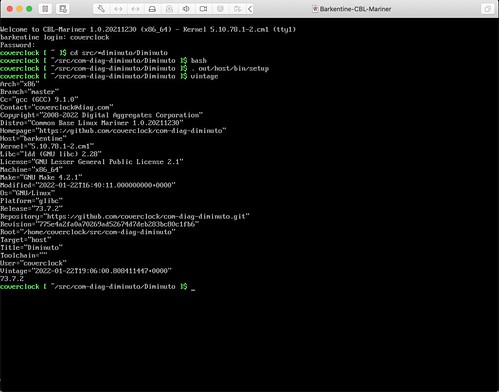
Remarkably, Microsoft has created its own Linux distro for the x86_64 target: the Fedora-ish CBL-Mariner (for Common Base Linux). It's intended as an internal Linux distro for Microsoft's Azure cloud infrastructure. I got it running as a virtual machine under VMware Fusion on my old desktop Mac. It works pretty well; I got my Diminuto C library and my Hazer GPS project running on it with very little effort.

Screen Shot 2022-01-25 at 10.05.16

It's not perfect: weirdly, it can't display the Unicode degree symbol, which is used in a couple of places in my Hazer code (gotta believe this is just a Unicode font issue). And the IPv6 unit tests in Diminuto don't pass 100% (current thinking this has nothing to do with CBL-Meridian, but with a change I made in my company web site). But otherwise I'm processing input as usual from a GNSS USB dongle.

Update 2022-01-25: The degree symbol display was a day-one bug in my Hazer code, related to setting the locale, that didn't manifest under Debian-based OSes. (If I had followed my own documentation, this would not have occurred.) The IPv6 issues were breakage caused by my own changes in the Digital Aggregates web site to support HTTPS and were unrelated to either CBL-Meridian or support in Diminuto for IPv6.

Tuesday, April 06, 2021

Ghidra 9.2.2

 Ghidra is an open source graphical tool produced by the U.S. National Security Agency (NSA) to analyze binary (compiled) software images for a wide variety of hardware targets and compiler platforms. Amongst its many capabilities are generating a disassembly listing and (remarkably) generating a decompiled listing back into C. This latter case requires that the tool recognize idiomatic instruction sequences produced by common compilers like GNU C, as well as deal with some special cases in which assembler code is inserted inline by the C developer, e.g. for memory barriers, low level synchronization primitives, and accessing special hardware registers.

The NSA released version 9.0 of Ghidra to the public just about two years ago. I wrote a couple of articles (see references below) here about using it to reverse engineer compiled code from my Diminuto, Hazer, and Scattergun projects. I did find a couple of bugs - multiple symbol tables in shared objects confusing the disassembler, and inserted memory barrier instructions confusing the decompiler - reported them, and got useful feedback from one of the developers.

Yesterday I installed the latest public release of Ghidra, 9.2.2, and tried two of the specific cases that were problematic that I wrote about in my two blog articles. Casual perusal of the Ghidra 9.2.2 disassembled and decompiled output for ARM7 binaries suggests both of these issues have been resolved. I updated both articles with remarks to this effect, and included screenshots of the updated output.

Reverse engineering has a lot more applications than just cybersecurity. Analyzing deliberate malware isn't typically my area; but debugging proprietary embedded software, and integrating my and my clients' new code with legacy systems, is an integral part of what I do for a living. Tools like this can be crucial for dealing with undocumented or under documented legacy systems. Reverse engineering tools like Ghidra should be in the toolkits of embedded and other low level systems developers.

References

C. Overclock, "Ghidra", 2019-03-25

C. Overclock, "Decoding Special Machine Instruction Sequences with Ghidra", 2019-03-26

Tuesday, March 23, 2021

Where the RF Meets the Road

My Hazer project (com-diag-hazer) - the basis for all my GPS/GNSS work that I've written about - depends mightily on my Diminuto project (com-diag-diminuto) - my C systems programming library and framework - for its infrastructure. Testing some of the Hazer features finally got complicated enough that I built a dedicated test fixture for that project, just as I had to build a little test fixture for  Diminuto that I described in Where the Silicon Means the Road.

Diminuto GPIO/Hazer 1PPS Test Fixture

While Hazer's gpstool utility supports a wide variety of GPS/GNSS receivers, the one I chose for the test fixture is a SparkFun board equipped with a u-blox NEO M9N device. Here is some gpstool output generated while exercising the M9N.

Hazer gpstool using a u-blox M8N

I chose the M9N because it can receive and process transmissions from the satellite constellations of the U.S. GPS (a.k.a. NAVSTAR) system, the Russian GLONASS system, the European Galileo system, and the Chinese BeiDou 2 (a.k.a. COMPASS) system simultaneously. This tests more code paths in the underlying Hazer library and in gpstool.

Diminuto GPIO/Hazer 1PPS Test Fixture

The M9N is powered by a USB C connection to a dedicated Raspberry Pi 4B running Raspberry Pi OS, the Debian-based version of GNU/Linux formerly known as Raspbian. The USB connection is also the serial communications channel between the Pi and the M9N. The Pi runs headless; when necessary, I ssh into it from my desktop Mac and use the command line interface (although in a pinch, I have connected up a display, keyboard, and mouse to the Pi, or even attached a USB-to-serial adapter to its console port pins).

Diminuto GPIO/Hazer 1PPS Test Fixture

You can see the SMA Radio Frequency (RF) connector emerging from the container, where it connects to the coaxial cable of the GNSS antenna used by the M9N. The small multi-band active patch antenna sits on the top shelf of my workbench within view of the window.

u-blox Multi-band Active GNSS Antenna

You can also see a green wire and a blue wire that run from the M9N container to the Raspberry Pi.

The green wire connects the 1PPS ("one pulse per second") signal from the M9N to a General Purpose Input/Output (GPIO) pin on the Raspberry Pi. 1PPS is a standard precision timing signal derived from the GNSS solution by the receiver (although not all of them export it, and when they do, the mechanism varies). I make use of 1PPS in all of my GNSS-disciplined Network Time Protocol (NTP) micro servers that I've written about previously, including the one that incorporates a chip-scale cesium atomic clock. When gpstool is configured to monitor the 1PPS signal, it uses Diminuto's GPIO feature to interrogate the input GPIO pin using the select(2) system call inside a dedicated POSIX thread (which is also a Diminuto feature).

The blue wire connects an second, output, GPIO pin on the Raspberry Pi to an LED in the little container where the M9N is mounted. When gpstool monitors 1PPS, it can be configured for the thread to strobe the second GPIO pin to follow the 1PPS signal. This is not just a test of Hazer and gpstool, but a test of Diminuto's GPIO feature as well.

Diminuto GPIO/Hazer 1PPS Test Fixture

My hardware engineer colleagues will confirm that I'm not a hardware guy by any stretch of the imagination. But hacking together these little hardware test fixtures gives me peace of mind. As long as I see that LED blinking at 1Hz, I know that, while my code is not perfect, it is at least sane.

Tuesday, December 29, 2020

First-Come First-Served Readers and Writers in C using Monitors

And so it came to pass that I needed a solution to the Reader-Writer Problem using POSIX threads and written in C. So that there would be a consistent perception of reality amongst the components of a real-time system, it would be required that the Readers and Writers be given access to the shared resource in the strict order in which their requests were made. So it was, in the fullness of time, I developed such a solution. And I found it was good.

The Reader-Writer Problem

The Reader-Writer Problem (or, sometimes, the Readers-Writers Problem) is a classic concurrency problem in computer science. I studied it in school in the 1980s, but papers were being published about it in the early 1970s, just as computers were large enough to actually run more than one program at a time, and shared databases were becoming commonplace.

A Reader is any algorithm that needs read-only access to a shared resource. That shared resources could be a persistent database, a complex data structure in memory, or just a variable. A Writer is any algorithm that needs read-write access to the same shared resource. The Reader-Writer Problem is all about how you keep Writers from stepping on each other and on Readers as they modify the shared data.

The classic example of this in all the introductory textbooks is your bank balance. An algorithm in the bank computer, Writer A, wants to see if you have enough money in your bank account to cover your ATM withdrawal of $200. It reads your balance, and sees that you have a balance of $500, and tells the ATM to give you your money. Meanwhile, Writer B want to see if you have enough money to cover a check for $400 drawn against your account. It reads your balance, sees that you do, and clears the check. Writer A deducts the $200 from your account. Writer B deducts the $400 from your account... and now you see the problem.

(The thing is: this actually happens all the time. The global banking system is distributed across a huge number of computers, and verifying every single transaction in real-time is too expensive and time consuming. The banking system reconciles all of the transactions at best at the end of the day. So sometimes you overdraw your account. But it works as an introductory example.)

So clearly the act of checking your balance and deducting the money needs to be done as an atomic, or indivisible, operation - without the balance being changed in the middle of the transaction. Hence, only one Writer can run at a time.

If all an algorithm is doing is reading - a Reader that just checks your bank balance - that is an operation that can be done concurrently with other read-only operations. Readers don't step on one another, and many Readers can run at the same time. For reasons of efficiency, there is no reason to block a Reader if only other Readers are running.

A Writer can step on a Reader, too. Perhaps a Reader accesses a shared account database to verify two separate things: that the password that was typed in matches the (probably encrypted) password in the database, and that the login entered has access to the specific resources that the user is trying to use. Both requirements must be met for the login to succeed, but the data that needs to be verified must be accessed in two different read operations. In between those two separate operations, a Writer steps in and processes a Change Password request. The result is that the Reader grants access, even though the password typed in was actually incorrect at the time access was granted.

(That probably happens all the time, too.)

So while multiple Readers can access a shared resource concurrently, Writer access must be serialized - only one Writer can access it at a time - and Readers have to wait until a Writer has completed and vice versa. Note how this is different than just placing each access of the resource, regardless of read-write semantics, inside a critical section protected by a mutex or a semaphore: that would unnecessarily serialize Readers' access as well as that of Writers. If most access is reading - which typically is the case - a Reader-Writer lock is far more efficient than a simple mutex.

Those are the basic rules, or invariants, for the Reader-Writer Problem. But typical solutions to the Reader-Writer Problem are more complicated than that. For example, if you have a constant stream of Readers, the simplest solution to the Reader-Writer Problem starves Writers; they are constantly blocked from modifying the shared resource as long as Readers keep requesting access, because the simplest solution gives Readers priority.

This doesn't really serve Readers either, since presumably a Reader wants the most up-to-date information in the database. Starving Writers really means that the data is old and effectively out of date with respect to the real-world - you have written a lot of checks that have not yet cleared, so your bank balance reflects what an accountant would call its cash basis, not its accrual basis. That makes the data the Readers are reading a lot less practically useful.

Likewise, giving Writers priority can starve Readers if there is a constant stream of Writers wanting to modify the shared resource. That's not useful either, since you have a database with a lot of up-to-date information that Readers cannot access.

So you have to have a balance. The devil is in the details, which is why there are a lot of different solutions to the Reader-Writer Problem, all maintaining the same basic invariants regarding the integrity of the shared resource, but with different scheduling and policy decisions for Readers and Writers. Each solution is designed to meet the requirements of some specific application, or exhibit some specific behavior, like Readers are given priority as long as Writers don't wait longer than some timeout period, establishing a kind of "best if used before" date on the shared data.

And so we come to the requirements for my solution.

My Reader-Writer Problem

I had some specific needs for my solution. Not only did I need to meet the basic invariants of the Reader-Writer Problem, I needed the requests by Readers and Writers to be performed in the time order in which they occurred. Readers can run concurrently, but as soon as a Writer waits for the Readers to complete, all further Readers have to wait. More importantly (and the thing that was the departure from many Reader-Writer solutions), subsequent Readers and Writers that wait must be granted access to the shared resource in the order in which they made their request.

For example, if the order of arrival of Readers (R) and Writers (W) were in the following time ordered sequence (from left to right)

R1 R2 R3 R4 W1 W2 R5 R6 W3 R7 W4 R8

  • R1, R2, and R3 would all immediately be granted concurrent access;
  • then W1;
  • then W2;
  • then R5 and R6 could run at the same time;
  • then W3;
  • then R7;
  • then W4;
  • then finally R8.

Other Reader-Writer algorithms may exhibit higher throughput for Readers, or for Writers, but this approach provides a more consist view of "causality", so that a post-hoc analysis of real-time system behavior agrees with the accepted perception of the order of events. I say "more consistent" and "accepted order" because a perfectly consistent view is impossible. I've written about this in my "Frame of Reference" blog articles, essentially applying Einstein's Theory of Special Relativity to real-time systems. (Computer scientist Leslie Lamport beat me to this idea by more than forty years.)

My Reader-Writer Solution

My solution is implemented in C under Linux using the GNU C library's implementation of POSIX threads, mutexen, and condition variables (and is different in implementation and probably behavior from the pthread_rwlock_t that POSIX provides - POSIX isn't that clear about how it behaves). You can find the source code in my Diminuto C systems programming library, whose Git repository is hosted on GitHub. Or you can follow the links below just to take a quick look at it right now.

diminuto_readerwriter.h

diminuto_readerwriter.c

unittest-readerwriter.c

The POSIX mutex and condition variable features together implement a form of synchronization originally referred to as a "monitor", as distinct from the earlier synchronization primitive, the "semaphore". Specifically, POSIX implements a Mesa monitor, whose behavior matches that of the monitors implemented in the Mesa programming language developed at Xerox PARC in the 1980s. Mesa monitors differ somewhat from the behavior of the original monitors described by C. A. R. Hoare several years earlier. I won't describe the POSIX mutexen or condition variables in detail, or either Mesa or Hoare monitors, but the references can be found below.

The one detail I do need to point out is that POSIX condition variables - a kind of queue on which threads can wait until another thread signals them to resume execution - do not guarantee First-In First-Out (FIFO) order: the order in which threads awaken on a condition variable can be completely different from the order in which they originally waited. POSIX condition variables are not guaranteed to be first come, first served. The order may be be affected by the scheduling priority that the application assigns to each thread, or it may depend on some specific detail of the underlying implementation. In any case, it is undefined in the POSIX 1003.1 specification. That was a problem I had to solve.

(There has been so much published on the Reader-Writer Problem over the decades that I would never claim that this solution is novel. It has undoubtedly been done before, and probably better. But a working implementation in the hand is worth two articles in the unread academic literature.)

(Update 2021-01-04: I found another, earlier, and very different implementation, by Shlomi Fish, which I added to the references at the end.) 

My solution uses one POSIX mutex, two POSIX condition variables (reader and writer), two counters that track the number of active Readers and Writers (reading, which should always be zero or greater, and writing, which should always be zero or one), and a queue used to store tokens (ring, which I implement as a ring or circular buffer).

(Update 2022-01-27: Diminuto library versions 74 and later do not require that the application provide storage for a ring buffer. The ring buffer is replaced by a diminuto_list_t, a doubly-linked "wait list", that is provisioned automatically and managed internally. The parameters to diminuto_readerwriter_init that provide a pointer to the ring buffer and its size have been eliminated. All other details remain the same.)

Once the Reader-Writer lock has been initialized, there are only four basic operations: a Reader can request access, a Reader can relinquish access, a Writer can request access, and a Writer can relinquish access.

Reader Request

When a Reader requests access and there are no active Writers (writing is zero) and there are no tokens on the ring, the reading counter is incremented and the Reader is granted access.

When a Reader requests access and there is an active Writer (writing is one), or if there are tokens on the ring, the Reader appends a READER token (indicating a waiting Reader) to the tail of the ring and waits on the reader condition variable.

When a waiting Reader wakes up, it checks to see if its token is at the head of the ring, and that it has been changed to READING (indicating a ready Reader). If both are true, it removes its token from the head of the ring, and proceeds to access the shared resource. (As we shall soon see, the reading counter will have already been incremented. This is important so that newly arriving Readers or Writers will not see the reading or writing counters as zero before the awakened thread has had time to reacquire the mutex.) If not, it waits again on the reader condition variable.

Just before a Reader exits the critical section that surrounds the Reader request mechanism, it checks to see if there is waiting Reader as the head of the ring. If there is, the exiting Reader changes the token at the head of the ring from READER to READING, increments the reading counter, and broadcasts a signal that wakes up all of the Readers on the reader condition variable. We have to use the broadcast POSIX function - which wakes all waiting threads - instead of the signal POSIX function - which wakes one waiting thread - because we don't know in what order threads will be awakened by POSIX, since FIFO order is not guaranteed.

Reader Relinquish

When the Reader relinquishes the shared resource, it first decrements the reading counter. If the reading counter is not zero, it is done. If the reading counter is zero (indicating there no other concurrent Readers), the relinquishing Reader checks to see if there is a waiting Reader or a waiting Writer by looking for a token at the head of the ring.

If there is a waiting Reader, the relinquishing Reader changes the token at the head of the ring from READER to READING, increments the reading counter, and broadcasts a signal that wakes up all of the waiting Readers on the reader condition variable.

Similarly, if there is a waiting Writer, the relinquishing Reader changes the token at the head of the ring from WRITER to WRITING, increments the writing counter, and broadcasts a signal that wakes up all of the waiting Writers on the writer condition variable.

Writer Request

When a Writer requests access and there are no active Readers or Writers (both reading and writing are zero) and there are no tokens on the ring, the writing counter is incremented and the Writer is granted access.

When a Writer requests access and there are one or more active Readers, or an active Writer, or there are tokens on the ring , the Writer appends a WRITER token to the ring and waits on the writer condition variable.

When a waiting Writer wakes up, it checks to see if its token is at the head of the ring  and that it has been changed to WRITING. If both are true, it removes its token from the head of the ring,  and proceeds to access the shared resource. If not, it waits again on the writer condition variable.

Writer Relinquish

When the Writer relinquishes the shared resource, it first decrements the writing counter. It then checks to see if there is a waiting Reader or a waiting Writer by looking for a token at the head of the ring.

If there is a waiting Reader, the relinquishing Writer changes the token at the head of the ring from READER to READING, increments the reading counter, and broadcasts a signal that wakes up all of the waiting Readers on the reader condition variable.

Similarly, if there is a waiting Writer, the relinquishing Writer changes the token at the head of the ring from WRITER to WRITING, increments the writing counter, and broadcasts a signal that wakes up all of the waiting Writers on the writer condition variable.

Practical Matters

The variables for the Reader-Writer lock are baked into a structure that has its own type definition.

diminuto_readerwriter_t lock;

The structure contains the mutex, the two condition variables, the counters, and the metadata for the ring buffer; the actual storage for the ring buffer is provided by the application in the form of an array that is at least as large as the maximum number of threads that may use the lock at any one time. Each slot in the array is just one byte. No initialization of the array is necessary. (My implementation doesn't have to do any initialization of the array either; the ring buffer metadata insures that the implementation never examines an uninitialized slot in the array.)

(Update 2022-02-01: In addition to the initialization function shown below, Diminuto library versions 74 and above also provide a mechanism for static initialization of the ReaderWriter lock structure. This allows the structure to be automatically initialized by the C run-time static initialization when an application starts.)

There is a function that initializes the ReaderWriter lock structure.

uint8_t ring[64];

diminuto_readerwriter_init(&lock, ring, 64);

Using the Reader-Writer lock is probably the simplest part, since all the necessary code is generated by C preprocessor macros that implement a "bracketing" pattern. These let you use the Reader-Writer lock like this, for Readers:

DIMINUTO_READER_BEGIN(&lock);

/* Read the shared resource here. */

DIMINUTO_READER_END;

or like this, for Writers:

DIMINUTO_WRITER_BEGIN(&lock);

/* Read and write the shared resource here. */

DIMINUTO_WRITER_END;

If one of the underlying POSIX functions fails for some reason (the most likely reason for this is the developer forgot to initialize the lock structure), the section of code bracketed by the macros is not executed. There is no error indication to the application, but it is a simple thing for the application to check that the code was executed. The implementation logs error messages either to standard error, or to the system log if the application has no controlling terminal i.e. is a daemon, so failures are not silent.

Discussion

Why two condition variables, one for Readers, and another for Writers?

Although I haven't tested it, my algorithm should work just fine having all of the waiting threads queued on a single condition variable. The waiting Readers and Writers don't depend on what condition variable they wake up on to know whether they've been granted access to the shared resource. There could be one token indicating READY that the head of the ring is set to, whether from a READER or from a WRITER, instead of the two different ready tokens, READING or WRITING. I think the only difference would be more churn amongst signaled Readers and Writers until all but one thread, the one whose token is at the head of the ring, go back to waiting.

Another approach would be to make every slot in the ring a condition variable. Each waiting thread would wait on its own dedicated condition variable. The signaling thread could signal instead of broadcast, since there would be no ambiguity as to which thread was being woken up. My only concern about this would be the resource usage involved.

I'm not unhappy about my design, so I'm not likely to change it. Using two condition variables seems efficient enough, and using a condition variable per slot in the ring doesn't seem necessary.

My design orders the access to the shared resource independently of the priorities of the calling threads, so it can result in priority inversion (but to not to do so would violate my own requirements).

One of the capabilities I have thought about adding is an optional timeout on the request for Readers and Writers, using a POSIX timed wait. I'm not completely convinced that there is a use case for this, except perhaps when recovering from some failure; how many algorithms have a credible Plan B if the request for the lock times out? It would also require that tokens in the middle of the ring be capable of being be rescinded. This is a lot harder than it sounds. Either the ring needs to be converted into something like a Diminuto List, a circular doubly-linked list (which would greatly increase the size of each slot from one byte to four pointers); or the maximum size of the ring can no longer be calculated (a Reader or Writer may timeout many times, each time adding a token to the tail while leaving an old token on the ring waiting to be removed at the head). I'm still pondering this.

(Update 2021-01-07: And I ultimately implemented the timeout, in part because it made it easier to test the recovery from certain failure scenarios. The timeout is available in the public function API, but not in the wrapper macros. You can find examples of both uses in the unit test. A timeout duration of zero provides a way for the application to poll for the availability of the resource.)

(Update 2022-01-30: As mentioned above, I finally replaced the ring buffer with a Diminuto List. The List node for each thread is automatically dynamically allocated in the thread's local storage and initialized on its first use. It is automatically de-initialized and freed when the thread exits.) 

(Update 2022-01-30: Diminuto library versions 75 and above support an expedited access request which queues the requesting thread at the head of the wait list instead of at the end. This provides a broad variety of alternatives in terms of how threads are scheduled to use the resource.) 

My Diminuto library and the results of its Reader-Writer solution should be pretty easy to reproduce on any modern Linux/GNU system. If this is the kind of thing that overclocks your processor, try it out. Clone the repository. Build the code base. Run the unit test. Peruse the code. See what you think. The unit test has passed on an x86_64 Ubuntu 18.04 platform, and on an ARMv8 Raspian 10 platform.

(Update: I made minor edits, and additions to the Discussion section, since I first posted this.)

For Further Reading

Wikipedia, "Readers-writers problem", 2020-11-23

Wikipedia, "Readers-writer lock", 2020-11-16

C. Overclock, "Frames of Reference IV", 2020-05-22

C. Overclock, "Frames of Reference III", 2020-01-28

C. Overclock, "Frames of Reference II", 2018-04-19

C. Overclock, "Frames of Reference", 2018-03-14

pthread_cond_timedwait, pthead_cond_wait, Open Group Base Specification Issue 7, 2018 edition, IEEE Std. 1003.1-2017, 2018

pthread_cond_broadcast, pthead_cond_signal, Open Group Base Specification Issue 7, 2018 edition, IEEE Std. 1003.1-2017, 2018

S. Fish, "A First-Come First-Served Readers/Writers Lock", 2009-04-18

B. Lampson, D. Redell, "Experience with Processes and Monitors in Mesa", Communications of the ACM, 23.2, 1980-02

L. Lamport, "Time, Clocks, and the Ordering of Events in a Distributed System", Communications of the ACM, 21.7, 1978-07

C. Hoare, "Monitors: An Operating System Structuring Concept", Communications of the ACM, 17.10, 1974-10

P. Courtois, F. Heymans, D. Parnas, "Concurrent Control with ''Readers'' and ''Writers''", Communications of the ACM, 14.10, 1971-10

Monday, December 14, 2020

Old Dog, New Tricks

In their article "File Descriptor Transfer over Unix Domain Sockets" in their blog CopyConstruct, distributed systems engineer Cindy Sridharan references an article by Facebook engineers and others that appeared in the proceedings of a virtual ACM conference: "Zero Downtime Release: Disruption-free Load Balancing of a Multi-Billion User Website" [Usama Naseer et al., SIGCOMM '20, 2020-08-10]. It's a real eye opener. I thought I was pretty conversant with the socket interface available in Linux, having been doing that kind of interprocess/interprocessor communication since my 4.2 BSD days on a VAX-11/750. Apparently I have some catching up to do.

Sridharan's article points out that you can transfer open sockets from one process to another, running on the same computer, via a UNIX domain socket, in the address family AF_UNIX (a.k.a. AF_LOCAL). UNIX domain sockets (or what I typically refer to as "local sockets") only work between endpoints on the same computer. Instead of using an IP address and port number, the rendezvous between endpoints is identified using a unique name in the file system namespace. Local sockets are have been around for eons, but I was not aware of this use for them.

What this is not is a child process inheriting a file descriptor from a parent process. This is sending a message over a local socket from one process to another that effectively results in a dup(2) system call on the receiving end for one or more file descriptors from the sending end that are specified in the message. The system calls involved are sendmsg(2) and recvmsg(2).

ssize_t sendmsg(int sockfd, const struct msghdr *msg, int flags);

ssize_t recvmsg(int sockfd, struct msghdr *msg, int flags);

Even the socket type was a new one on me: SOCK_SEQPACKET, which exchanges a message having fixed boundaries like a datagram, but which has guaranteed delivery like a TCP socket.

int listensocket = socket(AF_UNIX, SOCK_SEQPACKET, 0);

I had used sendmsg and recvmsg with struct msghdr before, to send and receive vector I/O using datagrams. You can find examples of this in my test program unittest-ipc-scattergather.c that I described in a previous article "Scatter/Gather".

But struct msghdr has additional fields that can be used to transmit additional ancillary information (the term used in the manual page). This includes control messages like SCM_RIGHTS, which enables the transfer of open file descriptors across process boundaries. (You still have to transmit at least one byte of conventional data, even if it is ignored by the far end; the control message tags along.)

You can find the test program described here at unittest-ipc-ancillary.c. In that program, there is one "main" process, one "workload" process, and four "instance" processes. 

The workload process manages a pool of sixty-four client threads. Each active client thread is trying to connect to the same listen socket identified by an IP address and port number. When the connection is established, the client writes one or more requests, and for each request reads a response from the server on the far end. Then the client closes the connected socket, returns itself to the thread pool, and ends. The workload process continuously waits for a client thread to appear in pool; it removes it from the pool and starts it.

Each instance process uses sendmsg to send a message to the main process over a local socket asking for the listen socket. The listen socket is a conventional socket identified by an IP address and port number, and has pending client threads waiting for their connection to be accepted. The main process receives the request using recvmsg and replies using sendmsg with its open listen socket to one instance process at a time until that process exits and its status is waited for by the main process. Then the connection request of the next instance process is accepted, and it is sent the same open listen socket.

Each instance process manages a dispatcher thread. The dispatcher thread continuously accepts connection requests on the listen socket from client threads, and assigns each new stream socket to one of eight server threads that it has started from a thread pool. When the client thread closes its end of the socket, the server thread returns itself to the thread pool and ends. During a single activation, a server thread services a sequence of requests from a single client.

The main process that drives the test gives each of the eight instance process ten seconds to service as many clients as it can before it is signaled by the main process to exit.

Here is a code snippet lifted from that test program for the sending side. diminuto_ipcl_packet_send() is the function in my Diminuto library that calls sendmsg.

struct iovec vector[1];

struct msghdr message;

union { struct cmsghdr alignment; char data[CMSG_SPACE(sizeof(int))]; } control;

struct cmsghdr * cp;

char dummy[1] = { '\0' };


vector[0].iov_base = dummy;

vector[0].iov_len = sizeof(dummy);

message.msg_iov = vector;

message.msg_iovlen = countof(vector);

message.msg_control = &control;

message.msg_controllen = sizeof(control);

cp = CMSG_FIRSTHDR(&message);

cp->cmsg_level = SOL_SOCKET;

cp->cmsg_type = SCM_RIGHTS;

cp->cmsg_len = CMSG_LEN(sizeof(listensocket));

memcpy(CMSG_DATA(cp), &listensocket, sizeof(listensocket));

ASSERT(diminuto_ipcl_packet_send(activationsocket, &message) == sizeof(dummy));

Here is a code snippet from the receiving side. Similarly, diminuto_ipcl_packet_receive() calls recvmsg. Note that the value returned by both sendmsg and recvmsg is the length of the dummy payload, not the length of struct msghdr or struct cmsghdr.

char dummy[1];

struct iovec vector[1];

struct msghdr message;

union { struct cmsghdr alignment; char data[CMSG_SPACE(sizeof(int))]; } control;

struct cmsghdr * cp;

ssize_t length;

int listensocket = -1;


vector[0].iov_base = dummy;
vector[0].iov_len = sizeof(dummy);

message.msg_iov = vector;
message.msg_iovlen = countof(vector);

message.msg_control = &control;
message.msg_controllen = sizeof(control);

ASSERT((length = diminuto_ipcl_packet_receive(activationsocket, &message)) == sizeof(dummy));

for (cp = CMSG_FIRSTHDR(&message); 
     cp != (struct cmsghdr *)0; 
     cp = CMSG_NXTHDR(&message, cp)) {
  if (cp->cmsg_level != SOL_SOCKET) { continue; }
  if (cp->cmsg_type != SCM_RIGHTS) { continue; }
  if (cp->cmsg_len != CMSG_LEN(sizeof(listensocket))) { continue; }
  memcpy(&listensocket, CMSG_DATA(cp), sizeof(listensocket)); break; 
}

The test program is constructed such that the listen socket being passed to each instance process doesn't even exist when the instance processes are forked. The only way the listen socket could be known to the instance processes is via the control message mechanism.

This is a remarkable capability. I own Cindy Sridharan a debt of gratitude for bringing it to my attention.

Addendum (2020-12-15)

Fazal Majid was kind enough to pass along the fact that this capability has been around for a long time, and cited a classic reference that I have on my bookshelf just a couple of feet away.

W. Richard Stevens, Stephen A. Rago, Advanced Programming in the UNIX Environment, 2nd ed., Addison-Wesley, 2005

It took me a few minutes to find it: 17.4.2, "Passing File Descriptors over UNIX Domain Sockets", pp. 606-614. I'm embarrassed to admit I missed this. In my defense, the book is 927 pages long. A big thank you to Mr. Majid for pointing this out.

Addendum (2020-12-16)

The SOCK_SEQPACKET socket type looks pretty interesting, doesn't it? It has the reliability of SOCK_STREAM with the fixed message boundaries of SOCK_DGRAM. Why don't we see it used more? Because underneath the hood it uses neither the Transmission Control Protocol (TCP) used for streams, nor the User Datagram Protocol (UDP) used for datagrams, the two transport-layer protocols on which most of the Internet is based. Instead, it uses the Stream Control Transmission Protocol (SCTP) developed for Signaling System 7 (SS7), the telecommunications protocol stack used to set up and tear down telephone calls in the Public Switched Telephone Network (PSTN). SCTP is defined in RFC 4960. SCTP isn't as widely deployed in the Internet at large as its peers in the transport layer. I'm not confident SCTP packets would make it through all firewalls. And it's not that hard to parse out fixed size messages from TCP streams. Diminuto provides an API to create a sequential packet socket only for the UNIX domain (local) address type, where it might be useful for inter-process communication on the same computer.

Tuesday, December 08, 2020

Scatter/Gather

The Linux kernel has a variety of I/O system calls that can be used to write data to and read from a file, device, or network. Which system call you use depends in part on how you want to treat the data, for example as as an unformatted (to the kernel anyway) stream of bytes, or as a fixed length datagram. Recently I was reminded of the readv(2) and writev(2) system calls, which read and write vectors of data which reside in non-contiguous areas in memory.
(Click on any image to see a larger version. Or any version of all, since Blogger doesn't alway play well with Flickr.)
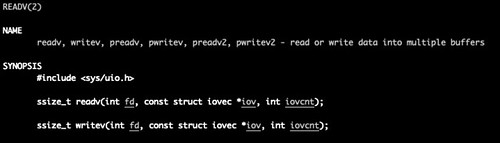
readv writev

These calls take, not a pointer to a buffer and a length in bytes, as is typical of other I/O system calls, but a pointer to an array known as an I/O vector (not to be confused with an interrupt vector), and a count of the number of positions in the array. (The readv and writev system calls are for streams; there are similar system calls, recvmsg(2) and sendmsg(2), that you can use for datagrams.)

Every array position in the I/O vector is an iovec structure. Each iovec structure contains a pair of fields: a pointer to the data to be written or a buffer into which data will be read, and the length in bytes of the data to be read or written.

iovec

I take it from the comments in the header file that readv and writev were originally adapted from the Berkeley Software Distribution (BSD), a UNIX variant I cut my teeth on decades ago on a DEC VAX-11/750. But it was later, at the National Center for Atmospheric Research in Boulder Colorado, where I was introduced to vector I/O, which was used to read and write ginormous lists of floating point numbers used in the specialized vector supercomputers at that national lab. Those high performance machines could do many identical floating point operations in parallel on those data vectors, multiplying and dividing dozens of numbers together all at once. I'm told vector I/O also has its place in high performance graphics hardware.

But my interest in vector I/O comes from the many years I've spend working in protocol stacks for technologies, like Asynchronous Transfer Mode (ATM) and cellular base stations, in the telecommunications industry.

Vector I/O

Supposing you want to transmit a packet whose wire format - what it looks like as it is transmitted over the network, not necessarily what it looks like in memory - looks like this. (This is a pretty simple example compared to typical network protocols.)

WireFormat

The wire format has five fields: a four-byte IPv4 address, a two-byte port number, an eight-byte payload length (which would be overkill for sure), a variable length payload, and finally a two-byte (sixteen-bit) checksum.

These fields may not be in a contiguous location in memory in the protocol stack. In fact, because of memory alignment requirements for the different fields, it may be impossible for them to be contiguous without copying each field byte by byte into a buffer as character data. Furthermore, the way protocol stacks are designed, these fields are probably not managed by the same software layers. By way of a trivial example, when creating an outgoing packet: one layer dealing with the application and business logic generates the payload; another layer responsible for packaging the payload and insuring it arrives intact adds the length field to the beginning and the checksum to the end; and a third layer whose duty is to route the data to the recipient adds the address and port number to the beginning.

One way I've seen this handled in production software is to do a lot of data copying and recopying. That tends to be expensive in terms of time and memory usage. Another way (which I thought was pretty clever, I wish I'd thought of it) was to use double-ended buffers: a single buffer was passed through the layers, the application put its payload more or less in the middle of the buffer, and each successive layer prepended and appended fields to either end. This still involves a lot of data copying from application variables into a contiguous buffer. I wondered if I/O vectors could be yet another approach to solving this problem.

You may have read or heard about zero-copy I/O. This is not that. Vector I/O is a way to eliminate copying in the application from variables to a buffer. Zero-copy I/O is a way to eliminate copying between user space where the application runs and kernel space where the device driver runs. For example: the application makes a zero-copy system call to write a buffer out to a device, file, or network. Instead of making a copy of all the application data from user space to kernel space and then releasing the application buffer, the kernel instead takes ownership of the application buffer, and later asynchronously notifies the application that the I/O is complete. The application can't mess with its own buffer until this notification arrives. It's possible to use both vector I/O and zero-copy I/O to avoid both types of copying (although my test program doesn't do that).

The application using writev instead populates an iovec array with pointers to, and the lengths of, each data field. When the data is ready to be written onto the wire (file, device, or network), the writev system call steps through the array and writes each field one by one in order. (The Linux implementation makes sure this operation is atomic, so a writev running in one process or thread can't intermingle fields with another concurrent writev.)

For our example packet above, the iovec array would look like this.

IOVector

Vector reads work similarly: the application using readv prepares an iovec array containing empty buffers and their lengths into which data will be read.

That's why this technique is sometimes referred to as scatter/gather: data read serially off the wire is scattered into separate memory locations instead of into a single contiguous buffer; data written to the wire is gathered from separate memory locations and serially written onto the wire.

I wanted to try out the various vector I/O system calls in Linux, so I wrote a little program to do just that. But I didn't want to do anything as prosaic just using iovec arrays. That would be too simple. I decided instead to try out an idea I've had for a long time: using a linked list to pass the data through the various software layers of a simulated protocol stack. And not any linked list, but the doubly-linked diminuto_list_t data structure I implemented in my Diminuto C systems programming library many years ago.

Lists

The Diminuto List implements a doubly-linked list - a linked list in which each node has a pointer to the next item on the list, as with a singly-linked list, and a pointer to the previous item on the list.
(You can find the source code for the Diminuto List implementation on GitHub at diminuto_list.h and diminuto_list.c.)
diminuto_list_t

Singly- and doubly-linked lists are familiar to anyone who has taken Data Structures 101. Doubly-linked lists have an advantage over singly-linked lists in that a node can be removed or inserted anywhere on the list. Diminuto Lists (or just Lists, with a capital L, for brevity) have a few other features besides the next and previous links.

DiminutoList

Each node on a List also has a link to the root of the list. This means that given any node on a List, you can find out what List it's on without traversing the List back to the root. So you can do things like trivially prepend or append a new node onto the same List as another node.

Diminuto Lists don't use null pointers, except for the data payload pointer, or as a returned value to indicate a specific condition. Lists are circular doubly-linked lists. The previous pointer on the node at the head of the List points back to the root note; the next pointer on the node at the tail of the List also points back to the root node. You know a node is at the head of the list because its previous pointer and its root pointer are the same. Similarly, a node is at the tail of the list because its next pointer and its root pointer are the same. When you insert a new node onto a List, that node inherits the root pointer from the node after which it was inserted.

Every Diminuto List node has a void * pointer that can point to a data payload. You can use this field by allocating nodes and payloads separately, and have each node point to its corresponding payload, whatever that is. Or you can embed an diminuto_list_t node structure as a field in the payload structure itself, and either ignore the data pointer, or use it to point to the beginning of the payload. You can have multiple node structures in a payload structure, so that the payload can exist on multiple Lists simultaneously; each node's payload pointer can point to the beginning of the containing structure; this eliminates the need to know which node structure you are using in a payload structure in order to compute the address of the beginning of the payload structure.

The root of a Diminuto List is just another node. You know it's the root node because its own root pointer is pointing to itself. Your application may choose to use the payload pointer in the root node for something, or just ignore it.

When a List node is newly initialized it looks like this.

InitializedNode

The node's next pointer, its previous pointer, and its root pointer are all pointing to itself. It is in effect the root of an empty List. Whether it remains a root node depends on whether another node is inserted onto it (then it is), or it is inserted onto another List (then it isn't).

As you insert nodes, the next and previous pointers in the inserted node and the adjacent nodes, as well as the root pointer in the inserted node, are all adjusted appropriately. Similar when you remove a node. Because a List is circular, there are no special cases about inserting, removing, appending, or prepending, a node on a List. And you can splice an entire List into another List; the root pointers in the spliced List will all be rerooted to point to the root of the List onto which it is being spliced. You can cut out a sub-List from an existing List, and reroot that new List to a new root node.

If you have a Diminuto List with five nodes plus the sixth root node, it looks like this. (I abbreviated the root node pointers so as to not make the diagram too tangled.)

FiveNodes

I don't use Diminuto Lists for everything: the overhead of the four pointers is overkill for applications where one suffices. But they have proven remarkable flexible. So it seemed like a good idea for this experiment.

Gather

The idea here is that different layers in the protocol stack incrementally build a packet by putting the value of each field to be transmitted into a payload buffer associated with a List node, then prepend or append (or even insert or replace) that node onto a List that will eventually represent the entire packet. When the packet is completely built, the application hands off the root node to a function which walks the entire List to build an I/O vector, and then passes the vector to a system call to put on the wire. 
(You can find the source code for this test program on GitHub at unittest-ipc-scattergather.c.)
The highest layer of the stack puts a node whose data payload pointer points to a buffer containing the data to be transmitted. In my test program, these buffers are allocated from a pool (as are the List nodes, from a different pool), and each buffer has a length field at its beginning. The start of the data field of a buffer from the pool is eight-byte aligned, so that its address can be cast to be a pointer of an application variable or structure; that pointer can be used via indirect addressing without copying values. In my test program, the root node is referred to as a record, and the nodes with payload buffers are called segments.

The record is, of course, initially empty. Once the payload segment is put on the record, the record looks like this.

OneField

The next layer of the stack prepends a segment at the beginning of the record that contains the length of the data to be transmitted in an eight-byte field. (The length is just taken from the length field in the payload segment's data buffer). It appends a segment to the end of the record that contains a two-byte Fletcher-16 checksum field that it computed from the payload data. The record now looks like this.

ThreeFields

The record gets passed to another layer that prepends two segments to the beginning of the record: one containing a four-byte IPv4 address, and another containing two-byte port number.


FiveFields

The record gets passed to a final layer that interrogates the address and port segments of the record to get the destination to which the record is to be sent. It then passes the record along with this information to a function which vectorizes the record: the function just walks the List from front to back, interrogating each segment for a pointer to the beginning of its data buffer and the value in that buffer's length field. It shoves each of these pairs of data into successive positions in the I/O vector. (This is the same figure as seen above.)

IOVector

It then calls the appropriate system call, writev(2) for streams or sendmsg(2) for datagrams, which puts the resulting serialized packet on the wire. (This is also the same figure as above.)

WireFormat
This completes the gather portion of the I/O. (With the appropriate abstraction and packaging into supporting functions, this was all a lot easier to code than it sounds.)

Scatter

The scatter portion of the I/O is almost the same operation, but done in reverse. But there is a complication: the payload portion of the packet is variable length, so the application has no way of knowing ahead of time what how large a data buffer to assign to the segment the represents that payload field, or what length to put in the I/O vector for the system call.

For datagram sockets, I solved this problem by having four segments, for four fields - address, port, length, and payload - instead of five. The last segment has a data buffer that is large enough to contain the largest possible payload and the two-byte checksum. The datagram receiver in the test program has to extract the checksum from the end of the payload buffer once the length is known. Because, like all good software developers, I'm a little OCD, I added the checksum as another segment which I appended to the record, and adjusted the length field in the payload data buffer by two bytes.

This solution doesn't work for stream sockets, because if there is a second packet behind the one we are receiving, the beginning of that packet would be read into the larger payload buffer past the data of the prior packet. I solved this problem by doing two vector I/O operations: the first reads the address, port, and length; once the length is known, the second reads the payload and the checksum. This solution isn't possible for datagram sockets, since datagrams are transmitted and received as a single unit.

Or you can ditch the entire vector I/O scheme on the receiving end completely. As my test program illustrates, the sender can transmit the packet using vector I/O, but the receiver can receive the packet using any appropriate scheme it wants. My test program implements a variety of ways of doing this for both stream and datagram sockets.

Remarks

I wrote the unittest-ipc-scattergather.c test program as a sort of audition for adding this kind of capability to the mainstream Diminuto library. I'm not convinced that it has broad enough applicability to make that worthwhile. But I rest easier knowing that I have a usable List-vector I/O scheme with a working example in my hip pocket.

Update (2021-03-19)

Today I made the scatter/gather capability a mainstream Diminuto feature. The function and type names have been changed to reflect the canonical Diminuto style. The feature now supports both IPv4 and IPv6 sockets. Additional unit tests have been added. The unit tests are now part of the sanity test suite for Diminuto. All sanity tests pass.